Showing posts with label Zaman Fahimah. Show all posts

Saturday, January 27, 2018

The Frugal Gourmet: Eggplant Dip

It's Fahimah, and I'm back with my final post!
I decided to have a touch of adventure with my last blog, and go with a vegetable that I don't necessarily enjoy. That's what turned me to the recipe for Melitzanosalata, or eggplant dip.

My mother hosts parties for our close family friends, and often spends the entire day cooking up a feast for our guests. She usually asks me for help making some sort of dessert or appetizer dish, and I like to stick with baking since it's more in my comfort zone. This time, I thought it would be fit to make an appetizer! I wanted to make a Greek dish because of my interest with the history of the ancient civilization. Smith mentions that during dinner parties, "... the host, a male, did all of the cooking for his guests. They were men of rank in the community, and they came to the dinner expecting to help" (Smith 389). Throughout earlier ages in history, we have been accustomed to seeing women stereotyped as the home makers. In ancient Greece, dinner parties were all about the male host being able to show his status.

To begin, I started off with roasting an eggplant covered in olive oil in the oven. This process was the longest part of the recipe, and took about forty-five minutes in a 375 degree oven. After taking out the roasted eggplant from the oven, I let it cool and then cut it into smaller pieces with the skin still on.

Brushed with oil, before roasting

After roasting

Then, I chopped up some fresh parsley, juiced half a lemon, and crushed two cloves of garlic. I added all of these into a blender, along with the cut eggplant, white vinegar, and olive oil. My blender wasn't incorporating everything so I had to mix the mixture with a spatula in between pulsing the blender. Last, I added in yogurt, cream cheese, and bread crumbs into the dip. It's important to add salt and pepper to the dish because it becomes quite sharp, especially with the vinegar AND lemon juice inside.
Eggplant with lemon, vinegar, parsley, olive oil, and garlic
Smith recommends refrigerating the dip for the duration of the night, to thicken the mix and let it cool because of the addition of roasted eggplant (Smith 393). This eggplant dip is creamy and perfect with crackers. I decided on sesame crackers, rather than plain crackers, because they added more of a crunch. It tastes quite tart, but the tartness balances out with the yogurt and cream cheese. Even though I'm not a fan of eggplant, it wasn't an overpowering note in the dip but it was still present. I'm also quite opposed to parsley, but that note was covered up by the lemon juice. I can definitely see myself making this for a dinner party in the future!

Are you familiar with Greek dishes? Do you like to serve a menu from one region during parties, or incorporate different regional flavors all together?

Blended mixture

Arrangement on dish

Smith, Jeff. “Greece.” The Frugal Gourmet, Ballantine Books, 1984, pp. 389–393.

Thursday, January 25, 2018

The Frugal Gourmet: Hunan Onion Cake

I'm back with another recipe! This time, I decided to cook a dish that I could have as a quick appetizer, so I went with Jeff Smith's Hunan onion cake recipe.

Ingredients

Smith's recipe for Hunan onion cake is straightforward and only requires tortillas, sesame oil, green onions, egg, and frying oil. The reason why the dish is very simple is because, "The Chinese dinner does not have a single dish that is the center of the meal. Rather, many dishes are served, in small amounts, of course" (Smith 351). With this in mind, I knew that the onion cake would be a sort of 'snack' rather than a whole meal.

The recipe itself uses a method of pressing tortillas brushed with an egg mixture together, with green onions in between. It's a much simpler version of a Bengali dish which I have grown up with-Mughlai paratha. Mughlai paratha is basically bread with an omelet inside. You have to fold it in a way so that the egg doesn't spill out of the bread when frying, which can be harder for newer cooks. Smith mentions that recipes with wheat are very common in the Hunan region of China, and it's usually made from scratch but he recommends using tortillas instead of homemade dough for a more precise result (Smith 352).

I mixed the sesame oil and water into the whisked egg, and then brushed this onto one side of a wheat tortilla. Next, I sliced up some green onions and sprinkled my desired amount onto the egg-coated side of the tortilla.To make it into a 'cake', you take another tortilla and brush the egg mixture onto it, and press down against the tortilla with the green onion. This method is very similar to making a sandwich!
Brushing on the egg wash

Sprinkling on the sliced green onion

I repeated this process three times, and placed wax paper between each tortilla to ensure they wouldn't stick together. When I completed the preparation of the onion cakes, I put weight on the stack per Smith's instructions, for about fifteen minutes. You can see below that I used jars and bottles in my kitchen, and also a meat tenderizer to ensure that the edges were sealed.

Pressing the onion cakes

To cook the cakes, I fried them in canola oil. The recipe suggests peanut oil, but I used canola instead since it was handy. The frying process is short and only takes a few minutes, but if you haven't sealed the edges properly the cakes will displace.

These cakes were crispy and delicious! I admit to being skeptical that Smith didn't add any salt, but the sesame oil ended up flavoring the tortillas very well. I would say this is the most successful dish I have done so far, since I enjoyed cooking it and can repeat this recipe again.

The finished cake, cut into wedges

Have you eaten a dish from outside of your culture that reminded you of a dish that your family enjoys? If so, have you recreated the dish before?


Smith, Jeff. “China: Hunan Treasures.” The Frugal Gourmet, Ballantine Books, 1984, pp. 351–352.


Sunday, January 21, 2018

The Frugal Gourmet: Spaghetti with Mushrooms

Hi friends!

For my third post, I decided to take on a dish that could be a little more challenging for me, concerning the preparation. So, I decided to take on a spaghetti dish with two different types of mushrooms!

This recipe required lots of multi-tasking. First, I had to soak dried mushrooms in warm water, then give them a rough chop. I also had to slice mushrooms but I purchased pre-sliced to save time. For washing the mushrooms, Smith mentions, "If you must wash them, just rinse them quickly, and then drain and dry them before cooking them" (Smith 231). I followed this method and let the mushrooms dry off while I prepared the spaghetti and sauce.

Re-hydrating the mushrooms


When cooking spaghetti, it's important to salt your water because your pasta will be tasteless without it. Smith recommends fresh pasta for these dishes, but if that isn't available to you pasta made from semolina or durum wheat is preferred since it isn't prone to becoming soggy (Smith 140).

After the spaghetti was cooked and drained, I began to prepare the sauce. First, I heated up olive oil in a steep pan and added pureed garlic since I didn't have fresh garlic. I also added garlic powder for more flavor. Second, I added the two types of mushrooms and let them cook for about six minutes.

Finally, I added the remaining ingredients including heavy whipping cream, salt, and pepper. Following this, I let the mushrooms cook in the pot for a few more minutes. This step took the longest because I had to decide when the mushrooms seemed to have soaked up enough of the cream.  I added the cooked spaghetti into the sauce pot and incorporated it into the sauce. It ended up being too dry, so I added in the rest of the cream instead of just the initial quarter cup.

Mushroom sauce with added cream

 If I were to make this dish again, I would have added the sauce to the pasta when serving rather than mixing it in. Jeff Smith actually recommends this, but I overlooked this step in the recipe. It ended up being a challenge to fully incorporate the sauce when the pasta was in the same pot. Additionally, I would have added less dehydrated mushrooms into the pasta. Fresh mushrooms have less flavor compared to the dry kind; the dehydrated mushrooms pack a punch!
Mixed spaghetti with sauce and cheese

This dish was really creamy and you could definitely taste the mushrooms. If you aren't a fan of mushrooms, you will not enjoy this recipe. This is a perfect winter time dish because it really fills you up! If you'd like a little less mushroom flavor ringing through, I'd suggest adding in shredded mozzarella or Parmesan.

Do you have specific techniques for cooking mushrooms? Have you cooked with fresh pasta before and seen a difference in flavor?

Smith, Jeff. The Frugal Gourmet. Ballantine Books, 1984.

Monday, December 25, 2017

The Frugal Gourmet: French Style Potatoes

Happy holidays! Hope you've all been having a relaxing break.
For my next dish, I wanted to make something that could be eaten during Christmas dinner; a last minute side to something like chicken or steak. I was drawn to Jeff Smith's potato recipes because he explained the intricate background of the starch, mentioning, "The bulb was brought to the American colonies during the early 1700s, and it proved to be a lifesaver. It also proved to be a problem. People began to depend upon the potato for daily food..." (Smith 246). Potatoes are very versatile and because of their lack of a sharp taste, can be blended into many dishes. So, I decided to make Jeff Smith's old French style potatoes.
Chopped potatoes

After washing the potatoes, I peeled and cut them into eighths instead of fourths, since they were quite large. Smith mentions to parboil the potatoes in salt water, which reduces cook time in the oven to around twenty minutes since uncooked potatoes take longer to fully cook (Smith 250).

Parboiling in salt water 

After parboiling the potatoes, I mixed a sauce with olive oil and flour. Smith advised adding parsley, but I chose rosemary since we didn't have any other fresh herbs. I advise you to really whisk this vinaigrette well, because the oil doesn't always fully mix with the salt and flour.

I first added lemon rind into the sauce per Smith's recipe, but then the sauce became very bitter so I decided to omit this ingredient. Instead, I decided to add garlic powder when I re-made the vinaigrette.

After mixing the vinaigrette, I put the potatoes on a buttered baking pan and poured the sauce on top, then mixed them. Jeff Smith's recipes suggest cooking them in a 450 degree oven, but since the potatoes weren't as crispy as I wanted them, I put my oven on broil and crisped them for a good three to four minutes after cooking them for twenty minutes at 450.

The finished product

I really enjoyed this recipe! The potatoes came out really flavorful and it was fun to experiment with tastes rather than fully follow a recipe. You shouldn't feel that you have to follow a recipe completely when cooking, because some of the best dishes turn out to be improvised!

Would you try improvising in the kitchen after reading this? Which dish have you made that was improvised?

Smith, Jeff. “The Potato.” The Frugal Gourmet, Ballantine Books, 1984, pp. 246–250.

Wednesday, November 29, 2017

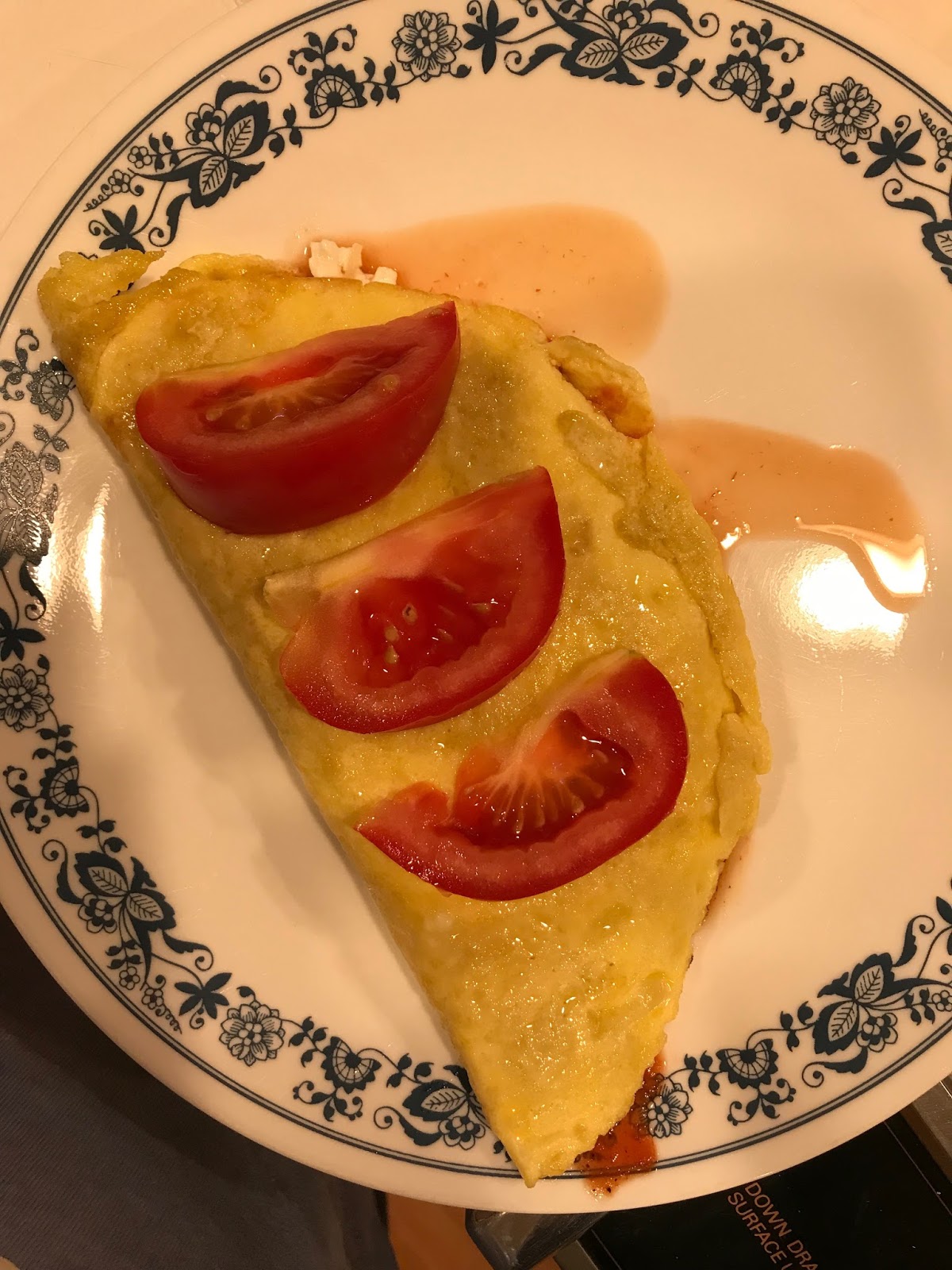
The Frugal Gourmet: Cheese and Tomato Omelet

I've always loved seeing people cook; any given Saturday morning my mom is usually chopping onions with ease and turning a few simple ingredients into a masterpiece. Food is a personal thing. Recipes reflect a person's taste. I, myself, am not very talented in the kitchen. Baking is more my forte; but this time, I decided to step out of my comfort zone.

I decided to turn to Jeff Smith's book, The Frugal Gourmet, to help me become better at cooking for myself. Today, I attempted Smith's cheese and tomato omelet.

For breakfast, I tend to turn to cereal. This time I decided to put a spin on eggs, something that I could eat as an alternative for breakfast. Jeff Smith offers his own method to make a basic omelet, and mentions, "Never use milk in the egg mixture. Use only water. Milk makes your omelet watery since it will not blend with the eggs. Water blends and keeps the omelet high" (Smith 106). This technique was foreign to me; I'm accustomed to seeing omelets made with milk. When I did add the water into the mixture, it was more thick than I'm accustomed to seeing. It kept the eggs smoothly together rather than separating apart.

Whipping the eggs

Heating up the pan
I then heated up the pan with oil and butter. Cooking the eggs wasn't challenging, but getting the uncooked egg to drip down the sides and cook was hard. Instead, I flipped the omelet over.  It was fluffy and rose as mentioned, the kind of omelet you usually want. I think the fluffiness is on account of Smith's technique, which mentions to skip mixing salt into the omelet mixture and instead adding salt when the egg is cooked to prevent hard eggs (Smith 106).  When I have made eggs in the past, I made this accident.  They turned out to be rubbery if not eaten freshly cooked. Eggs should be fluffy!

Overall, the recipe consisted of making a basic omelet and adding the cottage cheese, sauce, and then Parmesan. This recipe isn't for a grab'n'go breakfast. It's for days when you have a little extra time. I did like the combination of familiar flavors; cheese and tomato are versatile ingredients that you can whip up into any meal. Overall, this recipe is a nice shake up if you want to try something new for breakfast! It reminds me a lot of spaghetti because of the sauce inside, but it also is creamy because of the cottage cheese and Parmesan.

Finished product-some sauce spilled over
Which dish for breakfast have you made that requires a little bit more prep time? Is a meal for breakfast you would never attempt to make?


Smith, Jeff. “The Classic Omelet.” The Frugal Gourmet, Ballantine Books, 1984, pp. 105–108.