Showing posts with label sports. Show all posts

Sunday, January 28, 2018

Bigger, Leaner, Stronger: Supplements


        Bigger, Leaner, Stronger: Supplements


      Now that weightlifting is such a cultural norm, you have probably heard of most of the different kinds of things you can take, good or bad. One Idea that has stayed prevalent in the idea of weightlifting is that you have to take a lot of protein, with most of the sources coming from food and from "whey" a powdered substance that is added to drinks that adds protein to the mixture. To quote Michael Matthews, "Using protein supplements such as whey, egg, and casein powders (your three best options) isn't necessary, but its convenient." (Matthews 235) In the rest of the article, Michael Matthews talks about the different kinds of protein stimulants in depth, mostly about powdered supplements. To make a long story short, Mathews describes what the protein is actually doing in your body, and how to stay away from the bad and low quality whey or casein products because they have harmful fillers in them. For my project, I will be using all natural vegan protein, that has no sugar and is high in protein. I have not ever taken protein with a diet before, so i have no prior knowledge on what is the best types of protein and so on but for now, I would recommend the best ranked or best reviewed protein supplement you can find. 
 

         Work Cited

         Matthews, Michael. Bigger Leaner Stronger: the Simple Science of Building the Ultimate Male Body. Oculus Media Group Llc, 2015.

Bigger, Leaner, Stronger: Fueling your body


             Bigger, Leaner, Stronger: How to eat properly 


       An important part of bodybuilding and staying fit in general is to eat healthy and stay fit. In the book Bigger leaner and stronger, the author Michael Mathews sheds light on eating healthy with this quote: "Some people say it's 70 percent of the game, while others say it's 80 or even 90 percent. Well, I say its 100 percent."(Matthew 75) Michael Matthew also says that "the building blocks of a great body are more like pillars than puzzle piece. Weaken one enough, and the whole structure collapses."(Meyers 75) I agree with Mathews points because to become bigger,Leaner and stronger you need to eat good food as "Fuel" to become Bigger, Leaner and Stronger. I start my meal prep with healthy foods, mostly protein based. In the image below, I make Chicken Afritada, a Filipino dish that mainly consists of Chicken, Tomato, Potato and Rice. This meal is lean and full of protein and carbohydrates. I recommend that if you were to start a diet in order to get leaner and stronger, that you prepare yourself foods that will allow you to obtain the right nutrients that your body needs.

Work cited

Matthews, Michael. Bigger Leaner Stronger: the Simple Science of Building the Ultimate Male Body. Oculus Media Group Llc, 2015.


Thursday, January 25, 2018

Maintaining Focus and Motivation

For my last post, I decided to write about one of my biggest goals for this project: to maintain focus and motivation. In dance, as well as other aspects of my life, I have struggled with focusing on the end product. Typically, I become discouraged or distracted, leading to me abandoning my goals.

In Ballerina Body by Misty Copeland, Copeland dedicates a large portion of her book to talking about how one can stay motivated. In chapter two, she talks about why she believes goals are important. "Goals are essential. If you don't have clarity about what you want to accomplish, you can't plot how you will get there. And all of us need a spark to keep us energized and on task when we have those inevitable moments of feeling weary or discouraged" (Copeland 12).

Copeland recommends instead of taking one big leap, to talk small steps towards achievement. This in turn feels much more rewarding, and gives you a push to keep going. These small victories will help you stay motivated (Copeland 12).

Copeland also recommends to visualize some of your inspiration, whether that's a person or place. You can visualize where you want to be when your goals are achieved (Copeland 13).

I take inspiration from many famous dancers, one being Misty Copeland herself. Her story of hard work and dedication continues to inspire many young, hopeful dancers like she once was. I find motivation by looking at pictures of Misty Copeland.

Image result for misty copeland
Picture Credit: Orange County Register

I also wanted to focus on another point made by Copeland. Though results may not come immediately or be instantly satisfying, any progress is good. Any time that you put into achieving your goals is beneficial, even if improvement is minimal. "You're worth it. None of your effort, not a minute of your time, is wasted as you strive toward becoming your best, most vibrant self" (Copeland 13).

I've focused on my improvement over the past few months, before starting this project. I would definitely say that I improved my diet, and now have much more energy. This is extremely helpful for days when I'm normally dancing for 4-5 hours. I have also seen a lot of improvement in my balance, and find myself staying up on pointe longer.

I am also much more focused during class, and more attentive to my teachers. This also improves the quality of my dancing.

Focusing during Tap with my teacher
I would definitely recommend this book to anyone who loves dance, or just wants to learn new strategies to creating a healthy lifestyle. I found Misty Copeland's advice very helpful, and hope you will too.

How do you stay on track to achieving your goals? When you're feeling weary or discouraged, what keeps you going?


Copeland, Misty, and Charisse Jones. Ballerina Body. Grand Central Life & Style, 2017.

Thursday, January 4, 2018

Applying Mindsets

             Like any sport, the best volleyball players have an aggressive mindset. Each player has a specific mindset about each aspect of any game. The point guard in basketball often is looking for other players cutting towards the basket, the goalie in soccer is trying to keep every ball they can out of their goal, and swimmers and track athletes strive to get ahead of those they're racing against. These are all mindsets that many coaches try to teach their athletes. Just like in those sports and many more, volleyball has many mindsets that are applied into the game.
             Libero's for a team are often chosen because they chase after balls that aren't always exactly theirs. Good defense players must be willing to go after every ball to keep it off their side of the court. "Defense is as much an attitude as it is a learned skill. Players should obviously achieve good position and skills, but they must also have an attitude that makes them eager to pursue balls that do not go directly to them," (Dunphy, Wilde 79). Volleyball Essentials explains that volleyball is part physical, but most of all, it is a mental sport. Good players will do anything to keep the ball from dropping on their side. During my practices, I observed that there was an obvious difference between players who wanted the ball and didn't. Those who didn't want the ball often made mistakes when they had to take it and in tournaments, they didn't get as much playing time. Like most players, I wanted playing time, so I adjusted my mindset to wanting every ball and played on in a new style.
             While I did tend to get more balls up than I previously had, the change in mindset could not simply happen overnight. The best players have that mindset constantly and I could not just create a whole new playing style for myself in one practice. That said, applying an aggressive mindset to defense did improve my experience for me. Going after every ball eventually led to me picking up balls that I had not been able to get previously.
             An aggressive mindset is not the only way of thinking that leads to success in all sports.
Volleyball Essentials advises to analyze and anticipate serves and all kinds of ball that the other team sends over. Anticipating is a common thing that coaches tell their players because it will increase your probability of reaching the ball. The left back position in volleyball is often the player that is the best defender. They are placed there because that is the most likely spot that the outside hitter, often the best hitter on the team, will hit to. Anticipating applies to defenders because if they are always anticipating, then they will be able to be in the spot where the ball could be hit. I had tried to try this technique and it worked really well. With some balls, I was beat because I anticipated the hitter wrong, but I was able to dig the hardest hits because I saw where the hitter's shoulders were facing. I highly recommend trying both of these in any sport because it will not only likely improve how you play the game, but it also will create a more enjoyable experience with higher competition.
A diagram that shows the left back position (surrounded by the purple lines) anticipating the ball. This can be done by seeing where your blockers are (two red circles closest to the green player) and where the hitter's shoulders are facing. 

           What mindset makes a sport more enjoyable, a highly competitive one or a mindset where you only want to mess around and make each other laugh?


Dunphy, Marv, and Wilde, Rod. Volleyball Essentials: Video-Text. Total Health Publications, 2014

Friday, December 29, 2017

Using the Block to Play Better Defense

          In every higher level of play for volleyball, the block is the very first stage of defense against an attack by the other team. For front row players of any kind,  middles, outsides, or opposites, it is a fundamental to be able to put up a solid block that balls can't get by. based on my experience, the basics of this skill is clear: getting up as high as you can by using your legs and pressing over the net to the other team's side. However, the positioning is much more complicated as the whole defense in mostly the back row will be set up around your block.
          In Volleyball Essentials by Marv Dunphy and Rod Wilde, it says that, "Once the blocker has identified where the set is going, his or her focus changes from the ball to the attacker." (Dunphy, Wilde 73). Many coaches teach that the eye-work for blocking should be ball-setter ball-hitter. As the level of play gets higher, the sets get lower and faster. This is done to make it harder for the other team to get a block. When scrimmaging against my team who does quick and complicated sets, I attempted to minimize my vision of the ball as little as possible. And it worked more effectively than my previous style of blocking, which involved watching the ball for most of the time. This style allowed me to predict where the ball was most likely to go so that I could set the block up there fast, while previously I had been often late to get up on the block because I was busy watching the ball. Also because of my old technique, I would set the block up far inside because I was late and wasn't watching where the hitter wanted to place the ball.
         Another point about blocking that Volleyball Essentials makes is that after a crossover block, a sequence of footwork that is essentially running by the net, a player must reorient themselves to the net to make a correct block (Dunphy, Wilde 73). I didn't know that this was a downside to swing blocking, another name for the crossover block, and I started to observe that players would often go up sideways. Often, this would cause the ball to go in a direction that wasn't intended. When I went to block, I would make sure that my feet were straight towards the net when I was about to go up. There was an obvious difference with making sure you were oriented towards the net. The book's technique allowed me to use the momentum of the swing block and straight feet in order to put up a strong block that the ball couldn't get through.
         My question to you, from any stand point whether a player or not, is that do you think that orienting yourself to face the net is more important than getting to the place you're supposed to block?

Dunphy, Marv, and Wilde, Rod. Volleyball Essentials: Video-Text. Total Health Publications, 2014

Sunday, December 24, 2017

Serve Receive in Volleyball

                  Many coaches say that the two most important parts of the sport of volleyball are the serve and the serve receive that comes along with the serve. In order for a team to get a point, they must side out and win the serve receive. This means that teams must serve tough and pass well to be defined as a good team. Because of this, I support the idea that the aspects of serving in volleyball are the most important components of the game. 
                  For the last few practices, I have been working on the techniques that Marv Dunphy and Rod Wilde recommend in their book, Volleyball Essentials. A seam is defined as "the area between two receivers on a serve" (Dunphy Wilde 22). As I played with my team during practices, I began to notice that the servers would tend to serve those spaces and lots of times, the placement would tend to be effective. Noticing these trends, I found that calling which seams you would take if the ball landed there prepared me better to take the ball and make the good pass. Another result of me calling the seams before the other team served, was that my teammates talked as well. This led to all three of the serve receivers in at that moment to be a strong line that knew whose balls were whose. 
                   On the other end of serving, Volleyball Essentials helped me practice better techniques for giving the receiving team a tough serve or getting an ace, where the receiving team isn't able to send a playable serve back over to the other team. A floater is a type of serve that doesn't have spin, which causes the ball to move in various directions (Dunphy Wilde 22). Instead of sending the ball over only aiming to make the ball have a flat trajectory, I tried practicing this jump serve. Jump serving proved to cause the other team difficulty than standing and serving. Jump float serving caused me to become a more dangerous server that the other teams couldn't pass easily. In Volleyball Essentials, it says that the weakest areas in a serve receive are "deep corners, the sidelines, the short middle area, and the seams" (Dunphy Wilde 68). To put all of the serving strategies together, I created a jump float serve for myself that ended with my team getting more aces and getting easier balls from the other team in result of a tough serve. 
                    So comes a question concerning volleyball service. What is more important: serving or serve receive passing? Both are essential for a team to be considered great, but if you had to pick one over the other to be really good at, which would you choose?


Dunphy, Marv, and Rod Wilde. Volleyball Essentials: Video-Text. Total Health Publications, 2014

Thursday, December 21, 2017

Soccer: Techniques When Playing a Long Ball

During a game, there may be times when you need to "switch the point of attack", or switch the ball to the other side of the field. When trying to do this, you will have to play a long ball to the other side in order for the ball to successfully make it over to a teammate. You could also end up playing a long ball on a goal kick, on a cross, or even a long shot.

When trying to play a long ball, there are certain mechanics and techniques that can be used to improve your form and approach on the ball, which can help increase the distance and the flight of the ball. Andrew Latham says that the first part to hitting a good long ball is your form. You want to be a couple feet back from the ball so you have room to run up to the ball. When you are running up to the ball, you want to take the foot you are not kicking with and place it just next to the ball so you have some space in between your foot and the ball (35). My approach to the ball then sets my body up to strike the ball in a more comfortable and proficient way.


In the picture above, I used Latham's idea and planted my foot just slightly to the left of the ball, giving me a better position to strike the ball. My back is also arched giving me a better strike on the ball and allowing the ball to get more air.

When you are actually making contact with the ball and planning to play the ball, you want to make sure you are hitting the ball just the right way so you are accurate. "...you are striking the bottom half of the ball to get the ball in the air. On contact, you should be slightly leaning back, which also helps the ball go in the air. Kick through the ball. Your kicking foot should land across your body on the far side of your plant foot" (35).


While I was performing my long balls, I kept in mind Latham's information about form and approach. All of his idea helped me set up my body to strike the ball in such a way that I was able to hit over a 50 yard ball. If you were to look at both the video and picture, you would be able to see that my foot is planted next to the ball, my back is slightly arches back, I make contact with the bottom of the ball, and I strike my leg through the ball and onto the opposite side of my body.

Building on from just a simple long ball, do you think pro's incorporate these same techniques when they are taking freekicks on frame? How do you think they perform more difficult and skilled freekicks?


Latham, Andrew. Soccer Smarts for Kids: 60 Skills, Strategies & Secrets. Rockridge Press, 2016.  

Sunday, December 3, 2017

Football Warm-ups and Conditioning

Football involves many vigorous movements such as blocking, tackling, running, etc. It requires much flexibility, strength, and mobility. In order to perform these tasks at the best of your ability without injury one must prepare themselves by stretching and warming up."A warm-up decreases the risk of injury because it stretches the muscles, ligaments, and connective tissues; raises the temperature of the muscles and makes them more supple; and increases the heart and respiratory rates, providing more oxygen to your system."(Wright 27) Using the book Football: Sports Injuries: How to Prevent, Diagnose and Treat  I learned some tips and guide lines to warming up.


The first flexibility stretch i decided to do was for shoulders, chest, and arms. "Stretch the arms upward and backward."(Wright 30) This stretch improved my flexibility and range of movement in my arms and shoulder. while throwing the football over a 30 minute period i felt little to no fatigue and could throw better compared to not stretching my arms as said in my book "A warm-up will make the body more flexible and increase its ability to respond more quickly. Another benefit it that it will give you stamina over a longer period."(Wright 27)


The next stretch i did was the toe touch which works the lower back and thighs. When stretching and warming up movements become easier. My legs became more mobile and i felt more agile while running. This was because stretching increases your body's flexibility and makes muscles less tight which is important in many sports including football."Pregame stretching makes the muscle tissues less tight and even a bit longer. cold muscles resist stretching."(Wright 30) 


Warming up and stretching is a major key in all sports but especially in football which requires many complex and vigorous movements. Do you you think that stretching and warming up is that important in other sports too?

Wright, John D. Football. Mason Crest Publishers, 2005.


Thursday, November 30, 2017

Soccer: Basic Freestyle Juggling

Soccer is a sport that involves many different skills and techniques. Each skill will help you improve different aspects of your game. In this case, juggling is a technique that not only challenges you ability to stay focus and concentrate on control, but it also helps you improve on your first touch.
Andrew Latham says that your first touch is critical in soccer. Juggling will help you learn how to control the ball and keep your balance, which can help you in tight spaces or tough situations (49). Your first touch can set you up for a pass, a shot, a dribble, and practically any other action of making contact with the ball.

When I was juggling, Latham's idea of juggling helping you balance and teaching you how to have control, helped me create a rhythm during my juggling. I had to make sure that I was on balance and stable with my plant foot, so then it would be easier for me to make contact with the ball and keep it up in the air. In the picture below you can see how my right foot is planted and balanced while my left foot is making contact with the ball and keep it in the air.


Not only was having a rhythm and being balanced help me do well in freestyle juggling, but having the right technique to make complete and good contact with the ball was probably the most helpful tip in my juggling process. "Most of the time, your toe will point up on contact to spin the ball back so you can keep it close and get lots of touches" (49). In the picture above and the video below, you are able to see how my toe is pointed up allowing the ball to have a backward spin, and bringing the ball right back down to my feet.

These tips and ideas that Latham provided really did help me improve my juggling ability and allowed me to get a new freestyle record of 407. I have also taken my juggling skills and build upon it doing tricks such as rainbows, foot holds, around the world, etc.

I would like to know your guys opinion and want to know if you think that back spin on the ball and short touches help you have more control on the ball? And i would also like to know what are some other tricks i could try in my juggling?

Latham, Andrew. Soccer Smarts for Kids: 60 Skills, Strategies & Secrets. Rockridge Press, 2016.                         


Wednesday, November 29, 2017

Conditioning for soccer: Flexibility

Joey Macauley
Complete Conditioning for Soccer
By: Greg Gatz

Playing soccer is more than just a competitive exercise, but it's dynamic and multifaceted. In the introduction to Complete Conditioning for Soccer, Greg Gatz explains that a strong and developing foundation for your flexibility, balance, agility, power, and speed are important for preforming at a high level. In chapter 3, he begins specifying on flexibility as he claims that its defined by your ability to move your body through a range of motions. Playing soccer involves a combination of coordinated muscle movements and actively increasing mobility through static stretching and dynamic routines with rhythm and tempo promotes an improving and quality performance (Gatz 25). Then, Gatz states, "I like to use three basic stretching techniques to develop flexibility in athletes: dynamic stretching, static stretching, and active stretching. Dynamic stretching... is a combination of movement drills and stretching that stimulate and prepare the body for an increased work load... Static stretching, or 'stretch and hold,' has a soothing effect on the body and is beneficial after training or competition... Active Stretching... is used as a recovery technique from heavy bouts of exercise (Gatz 26). Then, towards the end of the chapter, he includes recommended daily routines, drills, and stretches in order to effectively improve one's flexibility and preserve muscle health. For example...


[Stretch # corresponds with picture example # in which each stretch applies to the muscle strain from specific muscle coordination/movements]
(1) Side Groin Stretch for adductors (inner thigh) and hamstrings.
(2) Deep Forward Lunge Stretch for hamstring, glutes, and lower back.
(3)  Quadriceps Stretch for quads and hip flexors.
(1) Constant and agile changes in direction (Lunges, abrupt stops, cuts, etc.)
(2) An example of many different motions that require significant muscle coordination/stress (on glutes, lower-back, hamstring, etc.) at a single time.
(3) Per every shot (or something more than a 20 yard pass) your quads and hip flexors is put under stress that may put your muscle health at risk without periodic stretching for recovery and warm up.


Initially learning about the importance of flexibility I reflected on how poor my flexibility currently is, and has always been, and then how I rarely prioritize stretching at any point in time. This may explain why I'm too pathetic to even touch my toes "without bending my knees." Anyways, after reading this, I began integrating more static and dynamic stretching routines for isolated time periods before and after soccer training and games, along with after daily runs. I've noticed significant decreases in the strain and soreness of my muscles, especially in my legs. Also, my movements feel more liberal or fluid and has allowed me to endure physical actively longer. Then, after reading the quoted evidence that I found, it was interesting to learn that static stretching is for "after training or competition." This was a slap to the face because I'm sure most of you are aware that most organized groups for teams and whatnot statically stretch before games or performances to "loosen their muscles." Well, that's apparently wrong and after learning that, I have corrected the way I warm up and prepare for soccer or runs.

What activities are you involved in and how important is flexibility in order to perform well? Also, how would you, or how have you created a convenient schedule to stretch on a daily basis for the recovery and development of your muscles?

Work Cited: 
Gatz, Greg. Complete Conditioning for Soccer. Human Kinetics, 2009.


Monday, November 27, 2017

technique 1 'step out' in Aerial


          Hi everyone! Over these few months I will be blogging on new techniques to help my aerial. For those who don't know, an aerial is basically a cart wheel but with no hands. They can be used in gymnastics, dance, or just for fun. When I was in fourth grade I taught myself how to do one in my front yard and it has stuck ever since. I thought it would be a good idea to learn different techniques so that I could improve and use it in dance. Being a part of the chats at Kentridge I have to do many tricks and using better techniques will help me make my aerial more clean (look more put together).  I read the book Gymnastic Skills, tips, and Tricks by Jeff Savage. It was a very interesting book for me because i go to see different techniques to do tricks that I would have never tried before. His book gave me the inspiration of my first correction in my aerial. 

          The first technique from the book Gymnastics Skills, Tips, and Tricks, is changing my step out. The 'step out' is basically your landing. I usually do my aerial by landing one foot the opposite way from my start then rotating 180 degrees to face the same way I started. In the book it says how you should body should be in scissor position. The author explains how you should rotate as you would in a cart wheel, (like how I did before but without the turn around) facing the opposite direction as started (13). In the book, the author says, "Land in a step out, hold your feet a few inches apart. Most important, bend your knees slightly while landing" (Savage 13). Through this technique I learned to change my step out. I end my aerial as the book says by facing the same way you started. 

          By using this new technique it helps me be able to add tricks. In the images below you see that I do my tricks and land just as the quote said to. I found this technique to be easier on even ground like regular wood gym floor. Landing with your knees slightly bent helps so your knees don't lock or snap. Doing it on uneven ground, like sand, was harder because while prepping you would sink into the sand. Once I  get more familiar with the technique, it should be easiest over all.  

Question: Do you think that my original and new technique take different amounts of strength? 


Savage, Jeff. Gymnastics Skills, Tips, and Tricks. Berkeley Heights, NJ.: Enslow, 2012. Print.

Monday, January 30, 2017

How to be a good rebounder

Solomon Kairu
P4
Rebounding the ball is the process of catching the ball after bounces off the rim or backboard from a missed shot or layup. Due to the fact that rebounding revolves around who can grab the ball first, you rarely see short players in a basketball game trying to rebound. Generally it's the taller and bigger players such as the power forward and center that grab rebounds due to them being taller.

According to Clive Grafford, the author of the book "Basketball", says "Good rebound requires strength and determination. You can expect some contact when competing inside a crowded lane for the ball". (Grafford 34). What he's saying is that rebounding also requires determination and strength since they're many other players besides you trying to fight for the ball so you need the strength to fight for it. I applied this in my games because whenever my friend missed a lay up or a shot, I'd had to rebound for him. This knowledge has helped improve my overall skills. Anyway to do a proper rebound you have reach your arms out and cover your opponent. Then quickly jump and extend arms to grab the ball. Will you use this technique in your next game?


Sunday, January 29, 2017

How to dribble a ball

Solomon Kairu
P4
Like mentioned earlier in my 2nd blog basketball isn't just about scoring. It's also about protecting the ball and getting past the defenders by dribbling. Dribbling is considered a basic technique that can be easily mastered by anyone, including you reading this. A dribble is used when going for lay ups or to put yourself in a better position on the court. Don't dribble to be flashy or to show off to the crowd as this is unnecessary and could potentially lead to a steal and a turnover. Another thing about dribbling is that you shouldn't be carrying the ball under your hand when dribbling. That's a carry which is a penalty. But you don't just use the dribble for lay ups. You mainly use them to get past defenders. Using your dribbling skills to get past a defender is called a cross over. Cross overs requires you needing to use both of your hands when dribbling the ball and switching hands. Meaning just like with lay ups, skilled basketball practice dribbling with either hand. Clive Grafford mentions in his book "Basketball" that "Top players work tirelessly in practice so that they can dribble with both hands.This always them to get past opponents on either side" meaning that this a skill used by many basketball player to go through opponents on the left side and on the right. I've applied this to me to get defenders off me when in a game.

But that's not the only form of dribbling possible. They're more advanced dribbling techniques such as the "between the legs" dribble and the "behind the back" and the spin move. These techniques are harder to master than a regular cross over dribble but they can make getting past a defender easier. To do a regular dribble though you keep your knees flexed, then as the ball bounces on the ground reach for it with your fingertips. Don't dribble with your palm. Use your fingertips. If you want to dribble forward then you keep the ball ahead of you. Then move your wrist a little upwards to receive the ball before it bounces


My question to the audience now it this. Will this article help you cross people in a game?


Setting Up for the future (post 5)

So as this is my last post I thought I should reflect on the progress I've made over this time period while also showing what I'm going to do following this.

The best way to show the improvement I've made is through not only my pure times but also through the swim diary that Salo had talked about keeping. This shows more of the statistics that are all extremely important to how I ended up getting the time I got.

Displaying File_000.jpeg
(The Top is the current and the bottom is the original)

Now I went back to the book to try and figure out where exactly I should go from here. What I found where I should go from here is what Salo calls Period swimming. Salo explains it as, "the scientific and systematic process of designing a season by breaking it into various phases" (Salo 185). He then goes on to explain what explains the phases are. First you would start off your season off with preparation and training then moving on to build stroke specific strength. Then you should finish that phase in time for your big competition part of the season and once that ends spending some time with rest and recovery. (Salo 186).

So what I'll do now is talk to my coach about how we can work in the sets and training I've learned in to book into our actual practice. The final question I really have is whether or not you have noticed these four phases in some way in your sport season?

Wednesday, January 25, 2017

Smart Defenders and Base-running

FIELDING

I've been playing baseball all my life and still haven't perfected the art of catching a fly ball. To me, judging where a fly ball is going to land is the hardest thing to do as a defender on the field. Although my main position is in the outfield, I can tell that an outfielder gets a much larger applaud from their team when they catch a fly ball than infielders do when they simply field a grounder. Adair agrees that a ball hit straight to a player is the most difficult to judge and balls that are hit at different distances can look fairly similar initially (148). If you've ever played on a baseball team for more than a year, you've definitely heard the overused phrase "first step back". This line is said by almost every team to express how you must make stepping back your first instinct the moment the ball is hit because you can cover more ground running forward than you can from behind. "If he waits a couples of seconds to start running, he won't cover the 50 feet he needs to in order to catch the short fly that lands after another 3 seconds" (149). Outfielders have to make judgments, calculate distances, and maintain certain fundamentals in the matter of seconds while under the pressure of catching a ball. Unlike the infield, outfields don't have someone behind them to back them up if they make a mistake.

Basic fielding techniques for ground balls
Infielders have more plays to handle during a baseball game than outfielders do. I personally have not played a lot of infield recently and still struggle with fielding even an easy ground ball. There are many complexities with fielding and throwing a baseball during one single play. "A ball thrown 135 feet by the shortstop or third baseman to the first baseman's glove will take about 1.09 seconds. A player who throws a ball 5 mph slower will allow the runner to travel 2 feet farther" (155). This two foot difference will play a big role in an umpire calling the runner safe or out. To practice strengthening my arm and fielding tactics, I find it effective to throw a tennis ball against any large surface to practice basic fundamentals. The more comfortable I feel when I field a baseball, the greater the chance that I will make a better throw during a game. So, consistently practicing allows me to stay in my comfort zone even during pressure-filled moments.

Outfielders provide a strong line of defense that their entire team depends on during a game. Infielders are consistently pounded with plays that they must routinely make. Which position do you believe has the harder job during a game?

Adair, Robert Kemp. The Physics of Baseball. New York: Harper & Row, 1990. Print.

Tuesday, January 24, 2017

Continuing the Dryland (post 4)

So since I posted my last post I've continued the basic workout that Salo had said to start with. After doing them for a couple of weeks I felt ready for what he considered to be "the next step" in perfecting and improving my swimming abilities.

What he says you do after the basic work outs is you begging to work on your abdominal and the general core of your body. He says you need to work on your core because, "If there is a weak or broken link, it can compromise the integrity of the entire chain" (Salo 90). What he means by chain is each individual body part. And if one is weak than you swimming will suffer as a whole since the one part is messed up.

How he suggested you fix your core is through a series of workouts. These range from various forms of planks in different positions. Then also doing certain types of core stretches. He says that while doing these you go through steps of beginner, intermediate, then advanced. Switching from each level is determined with how easy each exercise is for you (Salo 92).
Displaying plank.jpegDisplaying leg  drop.jpeg
(On the left is me doing planks and the right is leg drops)

What i was wondering though with the new things tat I've read about Salo's book do you think that being weak in one part of your body will really hamper your swimming ability or is he over reacting that part?

Wednesday, January 18, 2017

The Swing

THE SWING

In my mind, hitting a baseball has always been considered the hardest thing to do in any sport. There's no doubt that no one can be triumphant in any other sport where they succeed only one-third of the time. Keeping my hands closer while swinging the bat has always been a great challenge for me, although I feel that is the most effective way to hit a ball. Adair would disagree with that. He believes that keeping your hands closer to your body for a longer duration throughout your swing creates more bat velocity. More arm extension during the swing slows your bat speed and decreases your control over the bat (31). No athlete would argue with an author with a Ph.D. regarding baseball, but I believe that my swing is more effective when I am the most comfortable with it. Maintaining control of my hands during a swing is one challenge, but baseball is a mind game; as a result, baseball comes down to how comfortable you perform, how focused you stay, and how much effort you put in.

The reaction time of a batter during the pitch determines where/whether they hit the ball. Adair explains the reaction time: "he will swing so that the hitting area of the bat strikes the ball squarely-he hopes! All of this takes time and judgement-and good judgment takes more time" (38). My biggest strength, in my opinion, is my hand-eye coordination. I can hit the ball very squarely and prefer executing rather easy hits than powerful ones. During each of my practices however, I try altering my swing little by little until I find the most effective one. Practicing keeping my hands in longer and generating a shorter, quicker swing allows me to feel more confident going up to hit with a newer swing.

The picture on the left shows me in a swinging stance with a soccer ball under my back shoulder. This helps with two things while swinging; forcing your hands close to your body and keeping your back shoulder level. It's very essential to maintain balance-leveled shoulders so that when you swing, you minimize the chance of hitting the ball directly up in the air.

Would an athlete perform better with a proven, technical swing or a comfortable, relaxed swing?

Adair, Robert Kemp. The Physics of Baseball. New York: Harper & Row, 1990. Print.

Saturday, December 31, 2016

Pitching Forms and Techniques

This position is known as "The Windup" because
it's motion is a multiple-step procedure of twists
and turns before throwing the ball.
If you ask any baseball player what is the most important job while playing, they will say pitching. Pitching is considered one of the hardest things to do in sports. "The pitcher must not only throw the ball so that it passes through the strike zone, he must throw so that the batter does not hit the ball squarely" (Adair, 48). Constant decisions are being made by the pitcher from when he looks at the batter to as soon as he throws the ball. With the potential of the game being on the line and everybody focusing on you, pitching can build stress when your whole team relies on your decision making.

This single motion pitching position is called "The
Stretch" where the pitcher takes multiple pauses
before deciding when to throw the ball.
The speed of a pitcher is one of the first things that is noticed when anyone looks at the person on the pitching mound. A 95-mph pitch will reach the plate in 0.41 seconds after release, a 93-mph pitch will be around 1.5 feet from the plate after 0.41 seconds, and a 90-mph pitch 3 feet (Adair, 60). A small difference such as a 2-mph slower pitch can cause such a large effect where the batter can be thrown off by a one and a half foot difference. I can't throw a 90 mile per hour pitch just yet, but to utilize what I can do, I make sure to throw fastballs and change-ups frequently.

Typically, a trained pitcher finds that when throwing a fastball, throwing it high and inside the strike zone is the best way to utilize it. If a change-up is thrown, you'd most likely find that pitchers locate it low and away from the batter (71). Although, a pitcher must mix things up while on the mound because he/she doesn't to throw a pitch that the batter is already expecting. When I first started pitching, I was around 11 years old and just threw the ball to get it over the plate. Now that I've practiced consistently and frequently, our coach wants me to focus on hitting certain locations while pitching because he truly believes that it will be my most deadliest pitching trait.

I personally love pitching because I enjoy finding new ways to throw off the batter. I look for patterns in the batter's swings and make sure I don't fall into patterns myself. If I'm facing a team that we've never played against, I usually pitch with the same comfortable patterns that I normally use. But, I wouldn't do the same with a team that I normally face because they can easily pick up routines that I might fall in.

What do you think will throw a batter off his game more effectively, changing the speed of a pitch or changing the location?

Adair, Robert Kemp. The Physics of Baseball. New York: Harper & Row, 1990. Print.

Friday, December 30, 2016

Soccer Throw-Ins

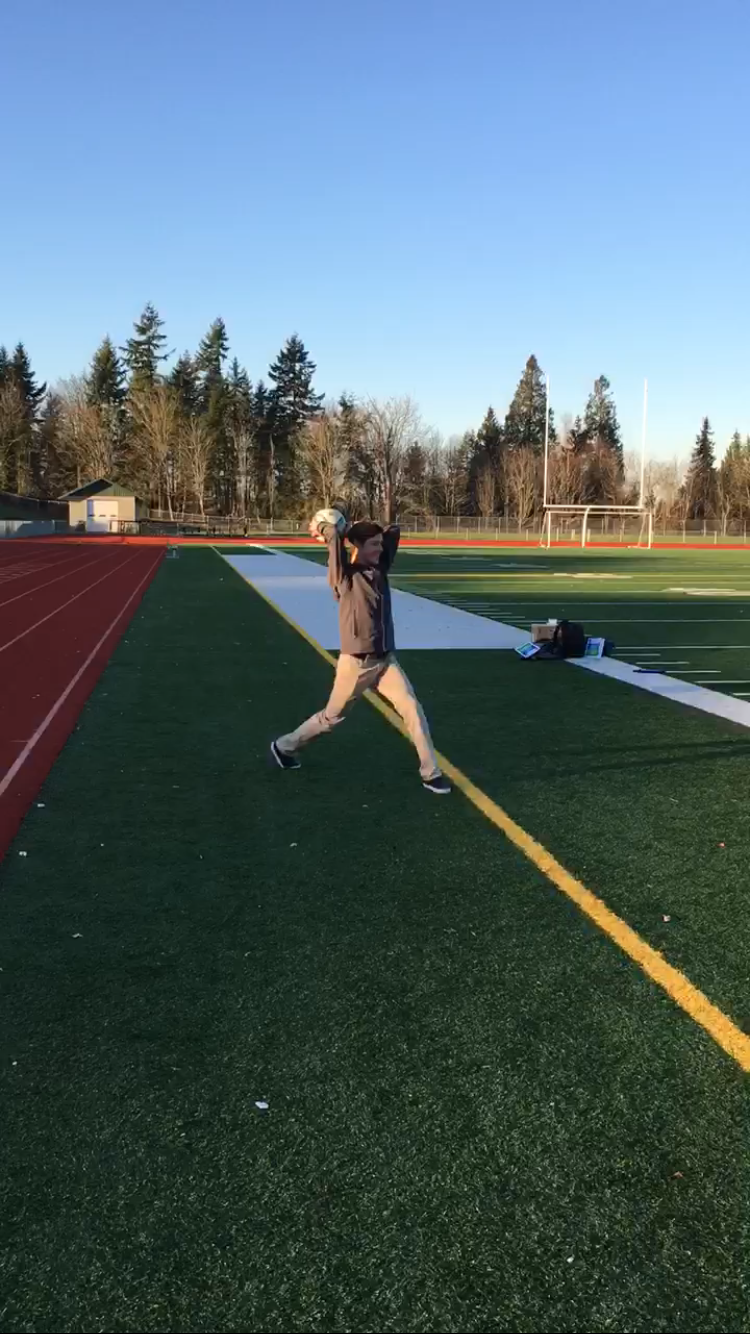
The next skill I needed to add to my repertoire was throw-ins. It is when you throw the ball back into play when it was put out of bounds, last touched by the opposing team. The goal of a throw in is to get the ball to a teammate so they can advance it forward.

I hit the field and started working on my throw ins. When I was just getting started, I was approaching these throws the wrong way. I have played basketball in the past and tried to make a throw in the same as a basketball inbound pass. I stood with my feet stuck in the ground and just used my arms for power in the throw.
So in the picture above, I had no momentum towards my target, and I didn't even have my shoulders squared up to my target. In my book it says, "Face the other team's goalie and thrown it to the sidelines in the right direction. Jump right back onto the field to be with the action when it occurs" (McCloud). So I took this information and kept working on getting better as a soccer player.
One of the things that was better in this throw was the momentum I created towards my target by getting a running start. Doing so increased my power in the throw because I engaged my whole body, not just my upper half. The running start also allows me to jump back into the field of play easier, since my momentum is carrying me in that direction already. Please leave me some feedback, let me know how I can improve my throws.

Wednesday, November 30, 2016

Soccer Penalty Kicks

Soccer is a something a had really disliked for quite a while. But recently, after watching big events such as the Euro Cup and World Cup, I have gained some interest in the sport. One of my most favorite parts of the games were when they went into extra time and eventually to a Penalty Kick Shootout. This is when each team switches off kicking 5 shots each from 12 yards out. Whenever a game is forced to this stage, the excitement and pressure is kicked up a notch. This is why I really enjoy watching it, PK’s get me fully immersed in the game and I can feel the excitement.
             
After getting inspired by these thrilling shootouts, I went out and tried it for myself. Now I have never played soccer in my life, so I definitely had some room for improvement. In my book I chose Soccer Strategies: The Top 100 Best Ways To Improve Your Soccer Game by Ace McCloud, it said “A big mistake strikers make is hitting the ball too hard and missing the goal entirely” (McCloud 14). As you can see in the video below, I did exactly that. I was too worried about kicking as hard as I possibly could to actually make sure the ball went into the net first.
So I went back to the book and tried to find some tips on improving my Penalty Kicks. "Shooting the ball in a good location is a vital skill that many people do not practice enough. Placing the ball in a strategic location is much more effective than trying to smash it into the goal with no real direction in mind" (McCloud14). This advice from the book was great. It showed me that PK's are all about strategy, you must think and place the ball in a good location. Just bashing the ball blindly will usually end up in a bad result. I took this knowledge, and learned from my own mistakes to improve my kicking prowess. I really focused on trying to keep my head down and place the ball in a spot.
In the video above I still kicked the ball pretty hard and nearly missed it altogether. Although I almost missed completely, the kick was actually really good because of how, 1. it actually went in the net, and 2. how difficult it would be for a goalie to reach, and block the kick from going in. I think overall, that kick was very effective, however the fact that I was so close to missing made it very unreliable to use in a real match. So for the next one, I concentrated extra hard on keeping the ball in the net, while still getting it past the goalie.
This last kick was my favorite out of them all. I made sure that the kick had enough force to get through the goalie, but this time, the accuracy of the kick was much better. The book definitely helped me to develop my Penalty Kick skills. The tip of kicking the ball softer was a major help with my accuracy of the kicks. I definitely progressed as I continued to practice my kicks. What do you guys think? Please let me know if you have any tips for me to improve my kicks!