Showing posts with label skills. Show all posts

Saturday, January 27, 2018

Stretching for Aerials blog post 5

          Hello! Thank you for coming back to my blog. This will be my final blog post! For my 5th blog post I'm not focusing on how to do my aerial, I am showing stretches recommended by Jeff Savage from Gymnastics Skills, Tips, and Tricks. It is a given that flexibility is very important in gymnastics, It's also very crucial you stretch to keep your flexibility also warm up your muscles so you don't pull one.
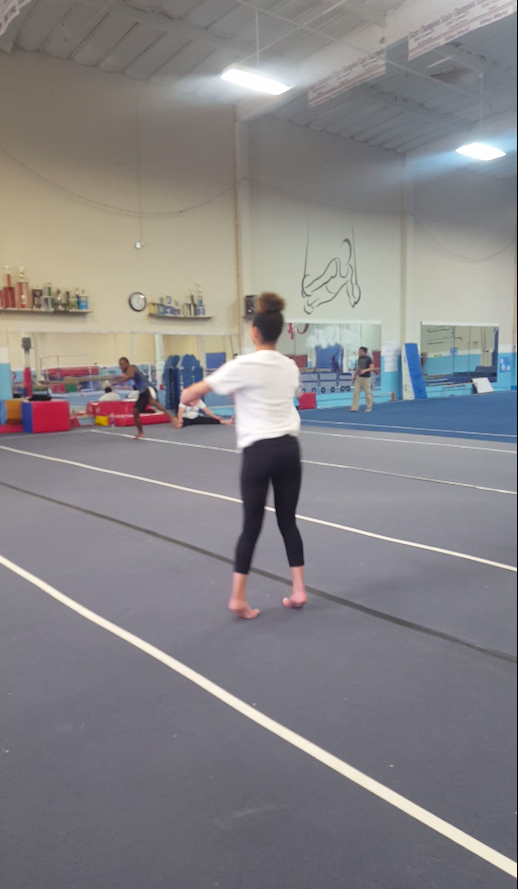
          Stretching is a key factor to be able to do tricks. You want to spend plenty of time stretching so your body can form in many ways. The reason I wanted to focus on stretching was because I know it is important, but I never stretch before doing tricks. Since I have been able to do most of the tricks I know for a long time, I don't feel the need for stretching. I am interested to see if stretching before doing my aerial would change and make doing aerials easier. Jeff Savage talks on how you must warm up first (Savage 42). Savage has many good ideas for stretching and warm up. He started off by saying "You need to get your heart pumping and blood flowing. Warm up with some jumping jacks or a light jog around the gym" (Savage 43). I used Savage's idea by doing 50 jumping jacks. This really got my heart racing and ready to stretch. Savage talks on how you must do splits, lungs, and neck rolls (Savage 43). Jeff Savage specifically explains how to do one of theses stretches by saying "Take a wide stance. Reach down and touch the floor" (Savage 43).  For stretching, I did that as well as all splits, rolling my neck and back stretches. While reading and analyzing the quotes, I was guessed these ideas would help me get over better in my aerial. After stretching, I was ready to try doing an aerial. 


          After stretching I tried doing an aerial and honestly there wasn't an aerial and honestly there wasn't a difference. I still got over perfectly fine, but not any better. Even though it didn't change my aerial, I decided I am still going to do this before I flip. The stretching felt really good and can help prevent from injury. Also stretching can help you from not being sore the next day which i like a lot! From past knowledge, I know stretching before and after you workout or do any physical activity is key for preventing soreness. Along with drinking water and coconut water. 
          I would like to thank you all so much for tuning into my blogs! It has been very fun sharing my passion for dance and gymnastics with you all! Thank you again for following me on this journey!

What tricks can you do? What's your favorite stretch?

Savage, Jeff. Gymnastics Skills, Tips, and Tricks. Enslow Publishers, Inc., 2012. 

Wednesday, January 24, 2018

Air Time in Aerial (blog post #4)

          Hello everyone! Welcome back to my bog. If you have never been to my blog, the purpose of my blog is to fix techniques in my aerial while in the air. This time I chose to fix what is did in the air. In the book Gymnastics Skills, Tips, and Tricks by Jeff Savage, there are many ideas to what to be working on mid-flight. I mostly focused on my head and arms. Throughout these blogs I have changed a lot about my aerial and have kept those changes. They have made my aerial a lot easier and I can see/feel a tremendous difference. One thins I was curious about was my mind air position. I never really focused on that, I only paid attention to getting over. 
          Author Jeff Savage, talks on body position as well as where your head should be in an aerial. As far as your body position you should be in a basic "straight" position in the air. The straight position is basically a pencil torso with scissor legs (Savage 6). Jeff Savage describes this in detail by saying "Hold your arms to your side, stand straight, hold your body tight by squeezing your muscles" (Savage 6). I believe the straight position is used to whip you around the fasted while making the trick look effortless and clean. The second technique to focus on in the air is your head position. Similar to blog post three, you have to spot, but this time you spot the ground. It is very important important to spot the ground in acrobatic tricks (Savage 12). Savage goes in to a deeper understanding of this by saying "Make sure you look down to see where you are going, At the the top of the move, you should be completely apart" (Savage 13).  I think this idea has a good concept but personally I'm guessing this won't help me. I feel the head position described would make me bend more backwards when the trick is suppose to be in a straight line. I sounds very dangerous.
          After trying these new techniques, there were a few problems. Like I had guessed, having your head arched back makes it nearly impossible to do an aerial. I couldn't take a picture because I put my hands down every time because it felt so uncomfortable and risky. To prevent injury, I decided to stop. For some people, this technique could have been helpful, which is why Jeff Savage wrote about it. On a good note, keeping my hands by my side looked very clean! It felt very comfortable and helped me whip a round fast.  


          My aerial is now very clean with all the changes made through this book! I am very pleased will the the results and feel all aspects of my aerial has been recognized and progressively gotten better. With this, my next blog will be on something other then flipping! Tune into my next blog post when I steer away from tricks and try something new!


What are your favorite stretches? What stretches do you think would be most helpful for aerials?


Savage, Jeff. Gymnastics Skills, Tips, and Tricks. Enslow Publishers, Inc., 2012.

Saturday, December 30, 2017

Soccer: Strike on a Volley

When you think about a competitive sport, such as soccer, you think of winning. And the only possible way to win a soccer game is to score goals. Now there are multiple ways to score a goal, for example you could simply score a 1 v. 1 goal. However, there are much more skilled and advanced ways to score a goal, such as a volley. A volley is a complex shot, but as long as you have proper coordination, a volley can be a great way to score a goal.

Now there are two types of volleys, there is a regular volley that does not hit the ground before you strike, and then there is the half-volley where the ball has a short bounce before it is kicked. For this concept, I focused on a regular, full volley.

When it comes to a striking a volley, you want your hips to be aligned with the ball and the target. You also want to make sure your body is balanced, your eyes are on the ball, making good contact with the ball, and pointing your toe down so your toes are below you ankle (42). Making sure that I was constantly watching the ball allowed me to create good contact that then enabled me to successfully strike the ball.


Once I practiced my volley using the little information above from Andrew Latham, I used some more precise details that helped me hit a much stronger volley. "On contact, strike the ball with your laces and lock your ankle joint. As you bring your foot through the ball, keep your toes below your ankle at all times. This will stop the ball from going in the air" (43). Keeping my toes down and hitting the ball with my laces made my volley much stronger and more accurate because I was able to keep the ball down.


Practicing these techniques and ideas has improved my volleying abilities and now I am able to strike the ball on a volley much stronger than I was able to before. The volley gives more opportunities to score a goal because it is a new skill that can be used for different goal scoring situations.

One question that I had when it comes to shooting and scoring goals is, which type of shot do you believe is easiest to score off of? For example, a header, ad volley, etc.

Latham, Andrew. Soccer Smarts for Kids: 60 Skills, Strategies & Secrets. Rockridge Press, 2016.  


Wednesday, December 27, 2017

Technique #3 Changing Run Up into aerial pt 2

         Welcome to my third blog! In my last blog, I went over what this blog was going to be on but for a recap, this is going to be changing my run up part two! There were two techniques in the book that I wanted to try, one was last blog and this is the second one. The second run up will be a chaines turn!

          The book this blog is based on, Top 25 gymnastics skills, tips, and tricks by Jeff Savage, had a lot of great information on chaines turns and using them as a run up. Instead of an actual run, a chaines is a type of turn. I chose to focus to focus on this because in a dance routine, a turn could look better than just running up. "A chaines is a three point turn that on the third step you use as a prep in to your aerial. The last step you need to make sure you do into a deep plie so you have enough power to do your aerial. Since you are turning in to it, it is very important to spot." (Savage 24). I think this will help me work on my strength in my aerial. Using just 2 steps and one prep takes a lot of strength for this chaines turn. Spotting is picking a point on the wall (or whatever you're facing) and looking at that point as you turn until your head cant reach to look at in anymore then whipping it around and continuing to turn and find that same spot (Savage 25). Spotting is very important when you add a trick after turning because it will help you not become as dizzy.


          Trying out this technique,  I went to  Metropolitan Gym. Using this skill was so far the most helpful. I would have never thought of turning into an aerial, but it comes very helpful in dance. Doing it on spring based gymnastics floor actually didn't effect the out come. I tried it on regular gym floor and dance floor and all three had the same positive outcome. I spotted hard so I didn't get dizzy and I noticed it worked really well. I tried not spotting and my aerial wasn't as strong and it was harder to do. Though it looks very nice it does take a lot more strength. In the book, Top 25 gymnastics skills, tips, and tricks, there are multiple workouts to help build up the strength needed. Even when I did spot, it still took a lot of strength. As you can see in the pictures, my head is pretty close to the ground compared to last week (you can see photos from then in my last blog), but i still feel very comfortable using this technique. It has changed me as a dancer/gymnast because it has made me gain more strength.

          Thank you so much for reading my blog! I'd like to end with the question of, what do you think the most used muscle is in an aerial? Why do you think the book says it takes so much strength to do this trick?


Savage, Jeff. Top 25 Gymnastics Skills, Tips, and Tricks. Enslow Publishers, Inc., 2012.

Thursday, December 21, 2017

Soccer: Techniques When Playing a Long Ball

During a game, there may be times when you need to "switch the point of attack", or switch the ball to the other side of the field. When trying to do this, you will have to play a long ball to the other side in order for the ball to successfully make it over to a teammate. You could also end up playing a long ball on a goal kick, on a cross, or even a long shot.

When trying to play a long ball, there are certain mechanics and techniques that can be used to improve your form and approach on the ball, which can help increase the distance and the flight of the ball. Andrew Latham says that the first part to hitting a good long ball is your form. You want to be a couple feet back from the ball so you have room to run up to the ball. When you are running up to the ball, you want to take the foot you are not kicking with and place it just next to the ball so you have some space in between your foot and the ball (35). My approach to the ball then sets my body up to strike the ball in a more comfortable and proficient way.


In the picture above, I used Latham's idea and planted my foot just slightly to the left of the ball, giving me a better position to strike the ball. My back is also arched giving me a better strike on the ball and allowing the ball to get more air.

When you are actually making contact with the ball and planning to play the ball, you want to make sure you are hitting the ball just the right way so you are accurate. "...you are striking the bottom half of the ball to get the ball in the air. On contact, you should be slightly leaning back, which also helps the ball go in the air. Kick through the ball. Your kicking foot should land across your body on the far side of your plant foot" (35).


While I was performing my long balls, I kept in mind Latham's information about form and approach. All of his idea helped me set up my body to strike the ball in such a way that I was able to hit over a 50 yard ball. If you were to look at both the video and picture, you would be able to see that my foot is planted next to the ball, my back is slightly arches back, I make contact with the bottom of the ball, and I strike my leg through the ball and onto the opposite side of my body.

Building on from just a simple long ball, do you think pro's incorporate these same techniques when they are taking freekicks on frame? How do you think they perform more difficult and skilled freekicks?


Latham, Andrew. Soccer Smarts for Kids: 60 Skills, Strategies & Secrets. Rockridge Press, 2016.