Showing posts with label soccer. Show all posts

Saturday, January 20, 2018

Recovery and Injury Prevention

Joey Macauley
Complete Conditioning for Soccer
By: Greg Gatz

Mental and physical stress on your body precipitates from daily occurrences, from school to athletics, in which your body is the forced to resist or adapt to. In chapter 11 of Complete Conditioning for Soccer, Greg Gatz justifies valid information and daily practices to allow your body to recover and remain healthy. Initially, he explains that in order to keep your body in healthy composition, it's important to avoid overworking yourself. In the text, he says, "To develop a sound training plan, you must distinguish between volume and intensity" (Gatz 155). In essence, he's prescribing that tough workouts correspond with shorter time periods, or easier workouts can last for a longer duration. This promotes better improvement and maintenance for the mechanics of your body while participating in sports. Furthermore, Gatz specifies on essential techniques for recovering properly. This involve a nutritious diet, regular hydration, quality sleep, and various exercises such as massaging methods. Being able to commit all these aspects to a consistent daily schedule will translate into noticeable forward progress throughout training processes and performances (Gatz 157). 

(1) STAY HYDRATED!!
(2) Using the foam roller for glutes, quads, and hamstrings (book example)
(3) My ice/heat pad, smaller knot roller, and foam roller... all for recovery and soothing my small strains or injuries 

Personally
, from playing soccer up to 5 days a week and with a possible 2 to 3 games a weekend, recovery is essential for me, day by day. After reading this chapter, I now understand the specifics for what I can and should be doing during and after training and competition to ensure that I continue maintaining and improving my muscle composition. The evidence I identified has altered the way I condition and train while making sure I'm avoiding injury or strain from overworking myself individually and with my team. Then, the information I paraphrased highlighted the check-list for the basics of what I need to incorporated while being involved with soccer. I know school hinders the amount of sleep I'm able to get, but I'm now aware of the extreme importance of hydration and nutrition, along with the use of different equipment to handle the soreness, knots, and stress with my muscles. 


Have you had to deal with over-stressing your muscles with an activity? If so, what methods did you do to recover efficiently, and if not, what would you have done?

Work Cited: 
Gatz, Greg. Complete Conditioning for Soccer. Human Kinetics, 2009.

Friday, January 5, 2018

Conditioning for soccer: Agility

Joey Macauley
Complete Conditioning for SoccerBy: Greg Gatz

While speed is the rate of which it takes to go from one point to another, agility is the level of efficiency to react to a stimulus. In chapter 8 of Complete Conditioning for Soccer, Greg Gatz focuses on this influential component of soccer and provides drills to pursue further success on the field. Essentially, agility training improves the execution of various coordinated body/muscle movements in space and with the nature of the body’s neuromuscular systems, improvements are quickly noticeable in one's performance after a few training sessions (Gatz 113). Additionally, Gatz further specifies beyond the basic definition of agility as he states, “Along with accelerating, agility involves reaction time, balance, coordination, stopping, and starting.” This leads to his elaboration on how to shape training programs as he introduces the division between the different drills, “Agility drills can be either reactive or nonreactive” (Gatz 114). In essence, non-reactive correlates with being able to anticipate something, and reactive drills challenge an individual’s ability to adjust to stimulus. Both are just as important when trying to dominate on the field and contribute to teams. Some of these drills include... 

(1) Shuttle Agility Drills: Sprinting 10 to 50 yard increments and using cones to incorporate changes of direction with sharp movements. Develops explosive strength, posture, and some balance
(2) Agility Ladder Exercises: Combination of many different patterns to speed up your footwork, coordinate your upper body with your lower body mechanics, and hones general athletic movements
(3) Line/Cutting Drills: Sprinting shorter distances and being able to change direction by isolating the position of your inside/outside foot to enhance explosiveness and balance for more muscle mechanic efficiency. 
Initially, I believed agility was simply being able to move quicker through improvised routes of adjusting to circumstances. However, after reading this chapter, Gatz added to my understanding to the multitude of concepts and mechanics that are involved in this component of soccer, along with how to individually improve it. The evidence that I paraphrased was not only the foundation to my aspiration to begin working on my agility, but also I was able recognize the distinguished movements that are often executed when I'm playing soccer. Then, the quotes I provided helped me form a simple program to isolate particular techniques and motions, which would translate in my performance on the field. Additionally, the evidence were parts of the chapter that influenced my knowledge of agility in order to effectively act on enhancing it. 

How did you perceive the definition and importance of agility in the activities you are involved in and what do you believe is the most important to focus on when conditioning this component?

Work Cited: 
Gatz, Greg. Complete Conditioning for Soccer. Human Kinetics, 2009.

Saturday, December 30, 2017

Soccer: Strike on a Volley

When you think about a competitive sport, such as soccer, you think of winning. And the only possible way to win a soccer game is to score goals. Now there are multiple ways to score a goal, for example you could simply score a 1 v. 1 goal. However, there are much more skilled and advanced ways to score a goal, such as a volley. A volley is a complex shot, but as long as you have proper coordination, a volley can be a great way to score a goal.

Now there are two types of volleys, there is a regular volley that does not hit the ground before you strike, and then there is the half-volley where the ball has a short bounce before it is kicked. For this concept, I focused on a regular, full volley.

When it comes to a striking a volley, you want your hips to be aligned with the ball and the target. You also want to make sure your body is balanced, your eyes are on the ball, making good contact with the ball, and pointing your toe down so your toes are below you ankle (42). Making sure that I was constantly watching the ball allowed me to create good contact that then enabled me to successfully strike the ball.


Once I practiced my volley using the little information above from Andrew Latham, I used some more precise details that helped me hit a much stronger volley. "On contact, strike the ball with your laces and lock your ankle joint. As you bring your foot through the ball, keep your toes below your ankle at all times. This will stop the ball from going in the air" (43). Keeping my toes down and hitting the ball with my laces made my volley much stronger and more accurate because I was able to keep the ball down.


Practicing these techniques and ideas has improved my volleying abilities and now I am able to strike the ball on a volley much stronger than I was able to before. The volley gives more opportunities to score a goal because it is a new skill that can be used for different goal scoring situations.

One question that I had when it comes to shooting and scoring goals is, which type of shot do you believe is easiest to score off of? For example, a header, ad volley, etc.

Latham, Andrew. Soccer Smarts for Kids: 60 Skills, Strategies & Secrets. Rockridge Press, 2016.  


Friday, December 29, 2017

Conditioning for soccer: Speed

Joey Macauley
Complete Conditioning for Soccer
By: Greg Gatz

Similar to the other components of soccer, including strength, flexibility, etc., speed can be taught and improved and isn't solely determined by inherited skill/potential. In chapter 7 of Complete Conditioning for Soccer, Greg Gatz defines speed and how to develop a program that incorporates drills and exercises that specify on the particular mechanics of your body. He explains how speed training for soccer should consist of combinations of acceleration, tempo changes, and multi-directional acceleration, which then correlates with the aspects of agility training. Also, Gatz warns that consecutive workouts dedicated to speed must be avoided to maintain forward progress by not over stressing the nervous system (Gatz 99). Then, Gatz specifies on how to design a program in order to effectively build upon your speed. He says, "To improve top-end speed, you need to understand and practice the basic mechanics of sprinting, including posture, stride frequency, and stride length..." (Gatz 100). Then, he adds, "When planning your speed development program, allow sufficient recovery between intensive bouts and adjust the volume to lessen the chance of over training" (Gatz 102). Following this information, Gatz lays out guidance plans and written tutorials for developing a speed program that incorporates various drills such as...
(1) Hill Sprints: Forces your steps to be quicker up and down. The resistance from the gradual incline works on your acceleration and stretches your muscles
(2-3) Get-up: Accentuates the driving force of acceleration and teaches you to use your arms to generate more power in motion. 
In essence, this chapter really taught me how to possibly increase my speed and agility which plays a major role in how players and teams are able to dominate. I now understand the correct methods or processes for how to improve my speed and I'm anxious to continue applying them to how I train. After reading the evidence I paraphrased, it now easier to strategically and effectively created a plan that will enhance the mechanics of my muscles, along with doing it safely in regards to muscle health. Furthermore, similar to how flexibility and balance training are separated into different styles of exercises, the quoted evidence that I included really made it more clear for me on what I could work on and what drills correspond with various focuses. All in all, I may not be the quickest player out there, but at least this chapter has given me valuable knowledge to keep moving forward. 

Do you consider yourself to have more speed then others? If so, how have you obtained it, and if not, what do you seek as the best plan in improving this component?

Work Cited: 
Gatz, Greg. Complete Conditioning for Soccer. Human Kinetics, 2009.

Thursday, December 21, 2017

Conditioning for Soccer: Balance

Joey Macauley
Complete Conditioning for Soccer
By: Greg Gatz

An individual's balance is an imperative component for playing soccer. In chapter 4 of Complete Conditioning for Soccer, Greg Gatz elaborates on the importance and effect for having heightened awareness and ability to control your body in space. Unless you're a cat that will always land and their feet, it takes precise and disciplined training to purse enhancing the mechanical processes of your muscles. Therefore, similar to how flexibility exercises are divided between static and dynamic stretching, balance exercises are defined as either strengthening basic posture control or dynamic stability. Basic posture control focuses on increasing the vitality and balance of the core while dynamic stability results in more coordination to efficiently execute combinations of vigorous movements in motion, or in other words, optimizing neuromuscular control (Gatz 45). Furthermore, Gatz interprets balance as he goes more in depth asserting that, "helping you move and react without losing control is the job of the processing mechanisms in the brain that maintain a state of equilibrium. The body also calls on proprioceptors to respond to changes in body position, center of mass, and muscles length" (Gatz 45). At the end of the chapter, he provides drills and routines to progressively improve one's balance and specifically train the internal muscle mechanisms that are responsible for the component of balance that influence and individual's performance on the field. For example...

Lateral Bounding: "Explosive" takeoff to land and "hold" on opposite foot, keeping your body in the air for as long as possible (repetition and incorporate different patterns of movement with same technique)
Single-Leg Squats: With one leg and both arms reaching forward, I "try" to squat to the lowest position maintaining balance, pausing, and extending back to the starting position.

After the enlightenment of this information the idea and importance of my balance became more than just the ability to stay on my feet. I never considered how our muscles can be treated as processes of mechanisms that can be improved through repetition and certain exercises. Personally, I'd say have pretty good balance because of how I've had to handle and react to taller and stronger competition my whole life and be able to successfully shift my body in a variety of movements in motion. However, after reading the text I paraphrased I've been determined to apply basic but challenging exercises to my conditioning in order to continue heightening my balance proficiency. Additionally, it was very helpful learning about what balance really is in regard to your muscle structures and systems. Lastly, my directly quoted evidence that I provided, again, instituted a better understanding for the concept of balance and its influence/importance while performing on the field. Consequently, this allowed me to more fully grasp this component which then arranged better direction towards being able to improve my balance. 

How crucial is your balance during the activities you're involved in, and how have you or would you pursue improving upon your balance?

Work Cited: 
Gatz, Greg. Complete Conditioning for Soccer. Human Kinetics, 2009.

Soccer: Techniques When Playing a Long Ball

During a game, there may be times when you need to "switch the point of attack", or switch the ball to the other side of the field. When trying to do this, you will have to play a long ball to the other side in order for the ball to successfully make it over to a teammate. You could also end up playing a long ball on a goal kick, on a cross, or even a long shot.

When trying to play a long ball, there are certain mechanics and techniques that can be used to improve your form and approach on the ball, which can help increase the distance and the flight of the ball. Andrew Latham says that the first part to hitting a good long ball is your form. You want to be a couple feet back from the ball so you have room to run up to the ball. When you are running up to the ball, you want to take the foot you are not kicking with and place it just next to the ball so you have some space in between your foot and the ball (35). My approach to the ball then sets my body up to strike the ball in a more comfortable and proficient way.


In the picture above, I used Latham's idea and planted my foot just slightly to the left of the ball, giving me a better position to strike the ball. My back is also arched giving me a better strike on the ball and allowing the ball to get more air.

When you are actually making contact with the ball and planning to play the ball, you want to make sure you are hitting the ball just the right way so you are accurate. "...you are striking the bottom half of the ball to get the ball in the air. On contact, you should be slightly leaning back, which also helps the ball go in the air. Kick through the ball. Your kicking foot should land across your body on the far side of your plant foot" (35).


While I was performing my long balls, I kept in mind Latham's information about form and approach. All of his idea helped me set up my body to strike the ball in such a way that I was able to hit over a 50 yard ball. If you were to look at both the video and picture, you would be able to see that my foot is planted next to the ball, my back is slightly arches back, I make contact with the bottom of the ball, and I strike my leg through the ball and onto the opposite side of my body.

Building on from just a simple long ball, do you think pro's incorporate these same techniques when they are taking freekicks on frame? How do you think they perform more difficult and skilled freekicks?


Latham, Andrew. Soccer Smarts for Kids: 60 Skills, Strategies & Secrets. Rockridge Press, 2016.  

Thursday, November 30, 2017

Soccer: Basic Freestyle Juggling

Soccer is a sport that involves many different skills and techniques. Each skill will help you improve different aspects of your game. In this case, juggling is a technique that not only challenges you ability to stay focus and concentrate on control, but it also helps you improve on your first touch.
Andrew Latham says that your first touch is critical in soccer. Juggling will help you learn how to control the ball and keep your balance, which can help you in tight spaces or tough situations (49). Your first touch can set you up for a pass, a shot, a dribble, and practically any other action of making contact with the ball.

When I was juggling, Latham's idea of juggling helping you balance and teaching you how to have control, helped me create a rhythm during my juggling. I had to make sure that I was on balance and stable with my plant foot, so then it would be easier for me to make contact with the ball and keep it up in the air. In the picture below you can see how my right foot is planted and balanced while my left foot is making contact with the ball and keep it in the air.


Not only was having a rhythm and being balanced help me do well in freestyle juggling, but having the right technique to make complete and good contact with the ball was probably the most helpful tip in my juggling process. "Most of the time, your toe will point up on contact to spin the ball back so you can keep it close and get lots of touches" (49). In the picture above and the video below, you are able to see how my toe is pointed up allowing the ball to have a backward spin, and bringing the ball right back down to my feet.

These tips and ideas that Latham provided really did help me improve my juggling ability and allowed me to get a new freestyle record of 407. I have also taken my juggling skills and build upon it doing tricks such as rainbows, foot holds, around the world, etc.

I would like to know your guys opinion and want to know if you think that back spin on the ball and short touches help you have more control on the ball? And i would also like to know what are some other tricks i could try in my juggling?

Latham, Andrew. Soccer Smarts for Kids: 60 Skills, Strategies & Secrets. Rockridge Press, 2016.                         


Wednesday, November 29, 2017

Conditioning for soccer: Flexibility

Joey Macauley
Complete Conditioning for Soccer
By: Greg Gatz

Playing soccer is more than just a competitive exercise, but it's dynamic and multifaceted. In the introduction to Complete Conditioning for Soccer, Greg Gatz explains that a strong and developing foundation for your flexibility, balance, agility, power, and speed are important for preforming at a high level. In chapter 3, he begins specifying on flexibility as he claims that its defined by your ability to move your body through a range of motions. Playing soccer involves a combination of coordinated muscle movements and actively increasing mobility through static stretching and dynamic routines with rhythm and tempo promotes an improving and quality performance (Gatz 25). Then, Gatz states, "I like to use three basic stretching techniques to develop flexibility in athletes: dynamic stretching, static stretching, and active stretching. Dynamic stretching... is a combination of movement drills and stretching that stimulate and prepare the body for an increased work load... Static stretching, or 'stretch and hold,' has a soothing effect on the body and is beneficial after training or competition... Active Stretching... is used as a recovery technique from heavy bouts of exercise (Gatz 26). Then, towards the end of the chapter, he includes recommended daily routines, drills, and stretches in order to effectively improve one's flexibility and preserve muscle health. For example...


[Stretch # corresponds with picture example # in which each stretch applies to the muscle strain from specific muscle coordination/movements]
(1) Side Groin Stretch for adductors (inner thigh) and hamstrings.
(2) Deep Forward Lunge Stretch for hamstring, glutes, and lower back.
(3)  Quadriceps Stretch for quads and hip flexors.
(1) Constant and agile changes in direction (Lunges, abrupt stops, cuts, etc.)
(2) An example of many different motions that require significant muscle coordination/stress (on glutes, lower-back, hamstring, etc.) at a single time.
(3) Per every shot (or something more than a 20 yard pass) your quads and hip flexors is put under stress that may put your muscle health at risk without periodic stretching for recovery and warm up.


Initially learning about the importance of flexibility I reflected on how poor my flexibility currently is, and has always been, and then how I rarely prioritize stretching at any point in time. This may explain why I'm too pathetic to even touch my toes "without bending my knees." Anyways, after reading this, I began integrating more static and dynamic stretching routines for isolated time periods before and after soccer training and games, along with after daily runs. I've noticed significant decreases in the strain and soreness of my muscles, especially in my legs. Also, my movements feel more liberal or fluid and has allowed me to endure physical actively longer. Then, after reading the quoted evidence that I found, it was interesting to learn that static stretching is for "after training or competition." This was a slap to the face because I'm sure most of you are aware that most organized groups for teams and whatnot statically stretch before games or performances to "loosen their muscles." Well, that's apparently wrong and after learning that, I have corrected the way I warm up and prepare for soccer or runs.

What activities are you involved in and how important is flexibility in order to perform well? Also, how would you, or how have you created a convenient schedule to stretch on a daily basis for the recovery and development of your muscles?

Work Cited: 
Gatz, Greg. Complete Conditioning for Soccer. Human Kinetics, 2009.


Sunday, January 29, 2017

Improve your body for soccer

Having on field skill is great, but in order for your body to perform these tasks, you must be strong and in shape. In order to do so, you must workout and get stronger so you can power through contact from your opponents. Ace says "To be on your game all of the time, you need to make sure that you are getting in the right work outs" (McCloud). While I have played baseball my whole life, my idea of work outs consist of a lot of upper body and core work.

One workout Ace recommends to do is Power Jumps. "When you can do a powerful jump, you are getting some new effects on your leg muscles. You can work all parts of the leg with these jumps" (McCloud).

"Then use all of your might to jump as high as possible" (McCloud)
"Get into a half squat to start" (McCloud) 

I completed 10 sets of 20 reps each of this workout. Ace was right, these power jumps truly engage all of your leg muscles. Doing these types of workouts will surely add to your muscle strength and endurance, both of which will pay huge dividends on the pitch. What do you do to get stronger? Comment some workouts for the sport you play.

Receiving the Ball

On my quest to continue to grow my offensive arsenal, I came next to receiving and controlling a pass. You must have a good first touch to set the ball up in a spot where you can either dribble or shoot. Also, having a bad touch could lead to a turnover if the ball gets too far away from you.

As is the picture above, my touch pushed the ball away from me, and made it easy to steal. Ace McCloud says, "All players should be able to receive the ball with just one touch. Using more touches increases the time that the other player can catch up to you and take the ball away"(McCloud). This touch of mine caused me to use more than one touch to gain control. This simply would not do in a game time situation.

Now after some more reps, I started to get the hang of it. My first touch left the ball right next to my feet. With doing so, I am easily able to control possession. I could shoot, dribble, or pass to a teammate instantly, which is essential to correctly receiving a pass.

Passing and receiving the ball are two of the most quintessential techniques in the game. They are used constantly throughout a match but are not easy to master. It takes a lot of time and effort to perfect these moves, especially when preforming them at game speed. So what do you think? What are some tips for controlling the ball better? Should I receive a pass off of my chest, knee, or leg?

Saturday, January 28, 2017

The 3 F’s


Another technique I learned to improve as a soccer player is The 3 F’s: focus, fun and freedom. In the book the author said, “The first stage of the 3 F’s is Focus. And quite simply this refers to creating, thinking about and focusing on the Script I introduced you to in Chapter 6 – as you play” (Abrahams 144). I did not think the script was going to help me a lot so I skipped it but now I think I am going to use it to improve my focus and concentration during the games. The author also said that the other 2 F’s are really close to each other and they are Fun and Freedom. He said that he wants his clients to have fun while playing and the freedom to play like the way they want (144). I think I do not have a lot of fun and freedom when I am playing soccer during my games because I am thinking too much about making a mistake and if I play the way I want, the coach and players might not like it and the way I play might not help the team. Now I think I am going to try to have more fun during my games and I am going to play the way I want to.


Do you think that the techniques that I learned can help someone improve their mindset or at the end it just comes down to the person wanting to improve their mindset?

Abrahams, Dan. Soccer Tough: Simple Football Psychology Techniques to Improve Your Game. Birmingham, UK: Bennion Kearny, 2012. Print.

Practicing


Another topic the author talked about was practicing for 10,000 hours and until now, I never really thought about counting how many hours I have played soccer or how many hours I was playing soccer in a week. In the book, the author said, “At the time, people thought that the really top violinists would train for fewer hours than the less accomplished musicians because they had natural talent and “didn’t need to practice”. But Eriksson discovered the complete opposite” (Abrahams 126). Including me, a lot of people think that some people who are really talented don’t work hard  or practice a lot but the author said the complete opposite and this made me think that if I want to get better I should maybe increase the hours I play soccer. The author also said that you need to have a balance in your training (137). This helped me realize that I am not practicing right; I need to work both on the physical and mental side of the game because until now I have only been working on the physical side of the game. If there isn't a balance than it won't really matter if i am really good if i don't have the confidence to show my skills or take risks than i won't be able to play at my best. In the picture below i am writing down a plan on what i am going to practice everyday.


Do you think practicing something for 10,000 hours will make you really good at it?

Abrahams, Dan. Soccer Tough: Simple Football Psychology Techniques to Improve Your Game. Birmingham, UK: Bennion Kearny, 2012. Print.


Thursday, January 26, 2017

The Maradona

This skill is one that needs to be practiced thoroughly in order to correctly do the move. If the move is effective, you’ll spin right by your defender and be on your way to scoring a goal. Ace McCloud, the author of “Soccer Strategies” says that “This is one of the hardest moves to perform, but if executed perfectly, it’s virtually impossible for the defense to stop it” (McCloud 21). The Maradona is a very difficult move to do, but Ace gives us step-by-step instructions on how to correctly do it. First, you dribble forward then place your right foot on the ball to make it stop. Then keep it there and jump in the air while doing a spin. During the spin, put your left foot on the ball, roll it forward, and continue on your way.


When I first tried doing the move I struggled with it. The YouTube link that Ace McCloud includes at the end of his description helps me to see exactly how the move is performed. I’m more a visual learner so this helped me out a lot. After trying the move about five times I started to get it down. Now it’s easy for me to do even with a defender in front of me. Just by reading a few pages out of a book, I added a new move to my game.


Are there any moves that you guys recommend I try out? I know some of the basic ones like the “Scissors” or the “Rainbow” but I’d like to add some more advanced moves to my arsenal. Thanks for reading and comment regarding any new moves.

McCloud, Ace. Soccer: Soccer Strategies: The Top 100 Best Ways to Improve Your Soccer Game. Charleston, SC: CreateSpace, 2015. Print.


Improving Your Throw-In Strategy

Throwing in the ball can be just as important as any other aspect in the game. A great throw-in can give your team excellent field position that could possibly lead to the scoring of a goal. Ace McCloud, the author of “Soccer Strategies” goes through a number of different techniques that will allow the reader to acquire more ways to throw the ball in. One of the strategies he describes is an attack down the sideline. According to Ace McCloud, the player need to “Face the other team’s goalie and throw it to the sidelines in the right direction” (McCloud 19). This action will give the team a down field attack and will open up the middle for other players to get position. As soon as the player throws the ball in, he needs to get inbounds immediately to become a safety valve for the person he threw it in to.

Example of bad throw-in form 
Ace McCloud does a great job at not only giving us his expert advice, but also giving us other sources to learn from. He gives us a visual representation of what we need to do to better our throw-in technique and improve our down field attack. Ace sends us to a YouTube channel named Epic Soccer Training, where they take you step-by-step through the throw-in process. The expert soccer instructor leading the video tells us that the first rule of throwing the ball in is not lifting up your feet. Although it may look like the superstars lift their feet when they throw it in, they’re really just dragging them on the turf. The dragging of your feet allows you to get the most velocity behind the ball.

Example of good throw-in form

After receiving some handy tips for throwing the ball in, I hope you can incorporate them into your game. Feel free to leave a comment below giving, or asking for more tips.

McCloud, Ace. Soccer: Soccer Strategies: The Top 100 Best Ways to Improve Your Soccer Game. Charleston, SC: CreateSpace, 2015. Print.

Exercises to Improve Your Game

To be on your game all of the time, you need to make sure that you’re getting in the right work outs. Running is one of the top exercises that will improve your overall game, but some extra work targeting specific muscles will do wonders to your abilities. Ace McCloud, a soccer expert goes in depth on a few workouts that drastically take your talents to the next level.

Squats:
Squats are one of the best workouts for building up your upper leg muscles. According to the book “Soccer Strategies” by Ace McCloud, “Increasing your squat by 50 pounds can add an extra 10 miles per hour behind your kicks” (McCloud 23). Squats are a great workout for strikers, the ones who have the most shots on goal, but are also useful for defenders as well. Having more power in your legs help when trying to body an opposing player off of the ball. If you don’t know what squats are, you begin by standing with your feet shoulder width apart. Keep your spine straight, stick your butt out, and lower your body until the knees are at a 90-degree angle. If you continuously perform squats correctly, you will see an improvement to the power behind your kicks, and your abilities to defend the opposition.


Uphill Runs:
Uphill runs take sprints to the next level by working out new muscles of the leg. When first performing these exercises your legs will become very sore the next day. This happens because you never work these muscles out. Uphill runs are a great workout because it doesn’t require any extra equipment, all you need is a nice sized hill to become a faster, stronger, and more athletic player. Adding speed to your game helps every position on the field not only on the defensive end, but also on the offensive attack.


There’s hundreds of different workouts that soccer players can do to become faster, stronger, and overall improve their game. These are just two examples that one can do without all of the fancy equipment that the pros use. After reading this blog post did it motivate you to want to get out there and work on your game? Maybe even try one of the workouts out?


Monday, January 23, 2017

Daydreaming


Another technique I learned to improve my mental part of the game is to think and visualize what I am going to do in my next game before the day of the game. By doing this I can have positive thoughts instead of negative thoughts. This will also help me remember my mistakes and if I know the mistakes I have done before, I will most likely make less mistakes. In the book Soccer Tough, Dan Abrahams said, “But the group that used both practice combined with “picture throwing” improved by up to 165 points: an incredible improvement and a remarkable difference between the mentally trained group and the group who just trained physically” (Abrahams 28). This quote helped me realize the importance of both training physically and mentally because before I started reading this book I was only doing physical training which helped me improve my skills but not my confidence but now that I am learning techniques to help my mental part of the game my confidence has also improved. Abrahams also said in the book that Wayne Rooney, a professional soccer player was probably imagining himself scoring goals and making runs the day before the game (30). Because of this quote I started using this technique before my practices and games because if a world class striker is using this technique and it’s helping him than it can really help me improve my physical and mental game. In the picture below I am thinking about how I am going to play at my practice tomorrow, like what are the things I am going to try to improve on.


Do you think imagining yourself playing in game a day before your game will affect you in a negative or positive way?


Abrahams, Dan. Soccer Tough: Simple Football Psychology Techniques to Improve Your Game. Birmingham, UK: Bennion Kearny, 2012. Print.

Saturday, December 31, 2016

Creating a Soccer Image


You need to be mentally strong every time you play soccer and a lot of players including me are not confident before and during a game. There are many ways to improve your mental part of the game and one way you can become mentally stronger is by having a positive soccer image. “Your soccer image rules your soccer game because these inner pictures and movies influence: how much belief you have in yourself to learn and improve, how good you feel you can be, how confident you are for match day” (18). “When you think about your soccer game what do you see? Take a few minutes to allow your mind to build a small picture book or short movie reel. This is a simple but important exercise to do every few weeks because it gives you an idea of your soccer image (17). This quote helped me realize the importance of soccer image and what my soccer image is right now. By visualizing my soccer image, I am able to see how I played in my game and see what are some of the things I need to improve and also I am able to think more positively about how I played during the game.

Now that I know my soccer image, I want to be able to keep it positive and make it better over time. Dan Abrahams also talked about a technique that will help maintain and build a strong soccer image. He said to write down 3 best games you have played and write down the important and positive moments during the game (24). This helped me remember my key moments of how I played and because I am writing them down I can reflect back on the key moments whenever I want and compare them to other games and that makes it easier for me to visualize my soccer image and make it stronger than before. Below I am using this technique to make my soccer image stronger.


Do you think you can play at your full potential without being mentally strong?
Abrahams, Dan. Soccer Tough: Simple Football Psychology Techniques to Improve Your Game. Birmingham, UK: Bennion Kearny, 2012. Print.

A Healthy Lifestyle

Foods all Soccer Players Should Eat
All players should have an equal balance of nutrition in order to stay healthy on and off the field. If you read my previous blog, you’d know that exercise is a critical component to keeping your body in shape. Ace McCloud, the author of “Soccer Strategies” says that “In addition to the exercise that you should be doing and the drills you need to practice, you need proper nutrition to keep the body going” (McCloud 10). Staying on top of your nutrition will allow you to become a better soccer player because they carry the necessary nutrients that will help you stay energized throughout the entire 90-minute game.

Turkey and Chicken
Turkey and chicken are lean sources of meat that will help you get the protein that is necessary for an athlete. These are great ways to acquire protein without all the added calories and fat that other food groups have.
Image result for chicken breast

Complex Carbs
Complex carbs include many different grains such as cereals, potatoes, pastas, bread, and rice. Eating these carbs in their whole wheat or whole grain forms is when you’ll get your best results. Loading up on carbs before a game or practice can help you play longer and have the energy you need to perform at a high level.
Image result for complex carbs

Milk
Drinking milk a few times a say is a good way to get a lot of nutrients into a meal. Choosing a low fat or skim variety will be giving your body lots of great nutrients, such a calcium, as well as avoiding the extra fat.
Image result for slim milk

It is very important to maintain a healthy diet while being an athlete. Eating these three basic foods will help to keep your energy throughout the entire game. I believe that a healthy lifestyle will allow you to improve and grow into a better player and will allow you to do more on the field.
What is your go-to meal before an important game? Do you think it helps you play better?


McCloud, Ace. Soccer: Soccer Strategies: The Top 100 Best Ways to Improve Your Soccer Game. Charleston, SC: CreateSpace, 2015. Print.

Friday, December 30, 2016

Soccer Throw-Ins

The next skill I needed to add to my repertoire was throw-ins. It is when you throw the ball back into play when it was put out of bounds, last touched by the opposing team. The goal of a throw in is to get the ball to a teammate so they can advance it forward.

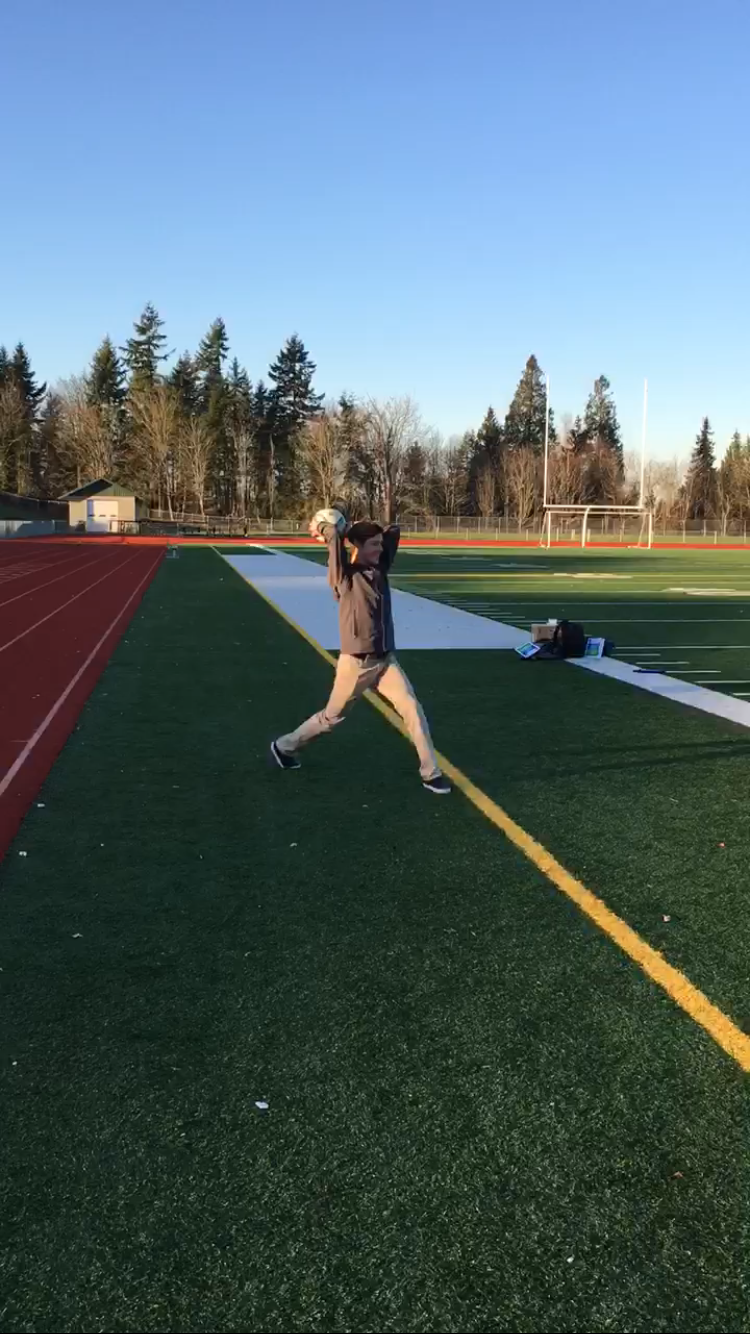
I hit the field and started working on my throw ins. When I was just getting started, I was approaching these throws the wrong way. I have played basketball in the past and tried to make a throw in the same as a basketball inbound pass. I stood with my feet stuck in the ground and just used my arms for power in the throw.
So in the picture above, I had no momentum towards my target, and I didn't even have my shoulders squared up to my target. In my book it says, "Face the other team's goalie and thrown it to the sidelines in the right direction. Jump right back onto the field to be with the action when it occurs" (McCloud). So I took this information and kept working on getting better as a soccer player.
One of the things that was better in this throw was the momentum I created towards my target by getting a running start. Doing so increased my power in the throw because I engaged my whole body, not just my upper half. The running start also allows me to jump back into the field of play easier, since my momentum is carrying me in that direction already. Please leave me some feedback, let me know how I can improve my throws.

Soccer Corner Kicks

In my journey to develop my skills as a soccer player, I knew that I would have to learn how to execute a corner kick. This is done after the ball is kicked beyond the goal line of the defending teams side, but not into the goal, and if it was touched by the defending team. The attacking team takes possession of the ball and it is placed on the corner arc where they can then restart play and put the ball back into the field. So when I went out and tried to start practicing my kicks, I was leaving the ball too far away from the goal. Even if my own team was able to get the ball, they would be too far away to do anything with it. 

As seen above, I kicked the ball too hard and over my teammates head. In a game this would lead to turnover, and that is not what you want to do with a corner kick. In my book Soccer Strategies: The Top 100 Best Ways To Improve Your Soccer Game, by Ace McCloud, it says "Most of the you will not be able to kick straight at the goal and get a good shot" (McCould). So like in the video above, I tried to kick a straight shot toward my teammates, and it was not successful. I needed to try and curve my kick so it could get closer to the goal and give my team a chance to put the ball in the net.
In this last kick, I was able to bend the ball closer to goal. As a result of that, I led my teammate towards the goal, making it easier for him to convert it into a score. I really had to practice working the ball from right to left, it is not easy to bend the ball to where you want it to go. Give me some feedback, do you like to kick your corners on the ground or in the air? What are some tips you guys have that might help me improve my own kicks?