Showing posts with label Training. Show all posts

Saturday, January 27, 2018

Strength Training: Low-Pulley Front Raises


Hello everyone! Welcome back to my blog.  I hope everyone is doing well and staying healthy during this rainy weather. Today, in this post I will be educating you on how to perform low-pulley front raises. This workout works many muscles which are both the middle and anterior deltoids and the pectorals.

The pectorals or, also known as pecs, are the major muscles that make up your chest. Low-pulley front raises strengthen the pectorals along with the deltoids and also make the muscles more toned and firm when flexed. In order to do this exercise follow the following steps. First, stand shoulder width apart with your arms by your side holding the dumbbells with a semipronated grip. A semipronated grip is the same grip you use to hold a hammer. To grasp the dumbbells in a semipronated way you lay the dumbbell in the palm of your hands and then form a fist around the dumbbell (Delavier 47). Next, inhale and slowly raise the arm forward up to eye level so your arm is parallel to the ground. After that, exhale and slowly lower the dumbbell to the starting position. I would recommend to do 10 reps each arm when you begin this workout and you can slowly increase until you are completing 15 reps each arm.


Low-pulley raises are great to improve the strength of your deltoids. Delavier writes "This exercise is excellent for people who have difficultly developing the anterior deltoid. The semipronated grip engages the humerus in external rotation, which at the beginning of the movement stretches the anterior fibers of the deltiod, allowing you to feel them working" (Delavier 47). Which means that this exercise improves the deltiod muscles. Also, the way in which you grip the dumbbells stretches the anterior fibers of the deltoid making the burn you feel from the workout more dramatic and makes you aware that you are performing the exercise properly.

After performing this workout, I learned some tips that may be helpful. When doing this workout it is important to extend your arms but don't over extend them. You want to still be able to bend your elbow. Do not lock your elbow because it can cause pain after completion of the exercise which is a sign of overuse. Another, helpful tip is make sure to contract your abdominal muscles because you want to maintain good posture to avoid back pain. Finally, a variation of this exercise is wearing a harness. Wearing a harness helps keep your abdominal muslces contracted to prevent back injury.

Ultimately, I enjoyed doing this workout for the most part. I liked the burn I felt due to the semipronated grip because it truly shows you are gaining something from this workout and strengthening your muscles. However, I did have some elbow pain after completing this exercise from overextending and locking my elbow. But, with more experience and practice this will no longer be a problem for me and the exercise will be truly enjoyable and beneficial. Thank you for reading yet another one of my blog posts. I hope you can use this exercise during your next trip to the gym. I am appreciative of your support and interest in my writing. Now that you know I injured myself from improper technique, have you ever suffered a injury from performing a exercise improperly?

Works Cited
Delavier, FreÌdeÌric. Strength Training Anatomy . Third ed., Human Kinetics, 2010.


Wednesday, January 24, 2018

Backpacking and Hiking: Training

Jason Stevenson, the author of the book, The Complete Idiots Guide to Backpacking and Hiking, states, "Your hamstrings, quadriceps, and glutes are often the limiting factor in how many miles you can hike" (Stevenson 69). I learned this first hand after finishing the Poo Poo Point trail last week and having very sore legs the next day. This caused me to realize I needed to work more on my leg strength in order to complete harder hikes. In this blog post I will be discussing the leg exercises I 
have been doing that were recommend by my book. 

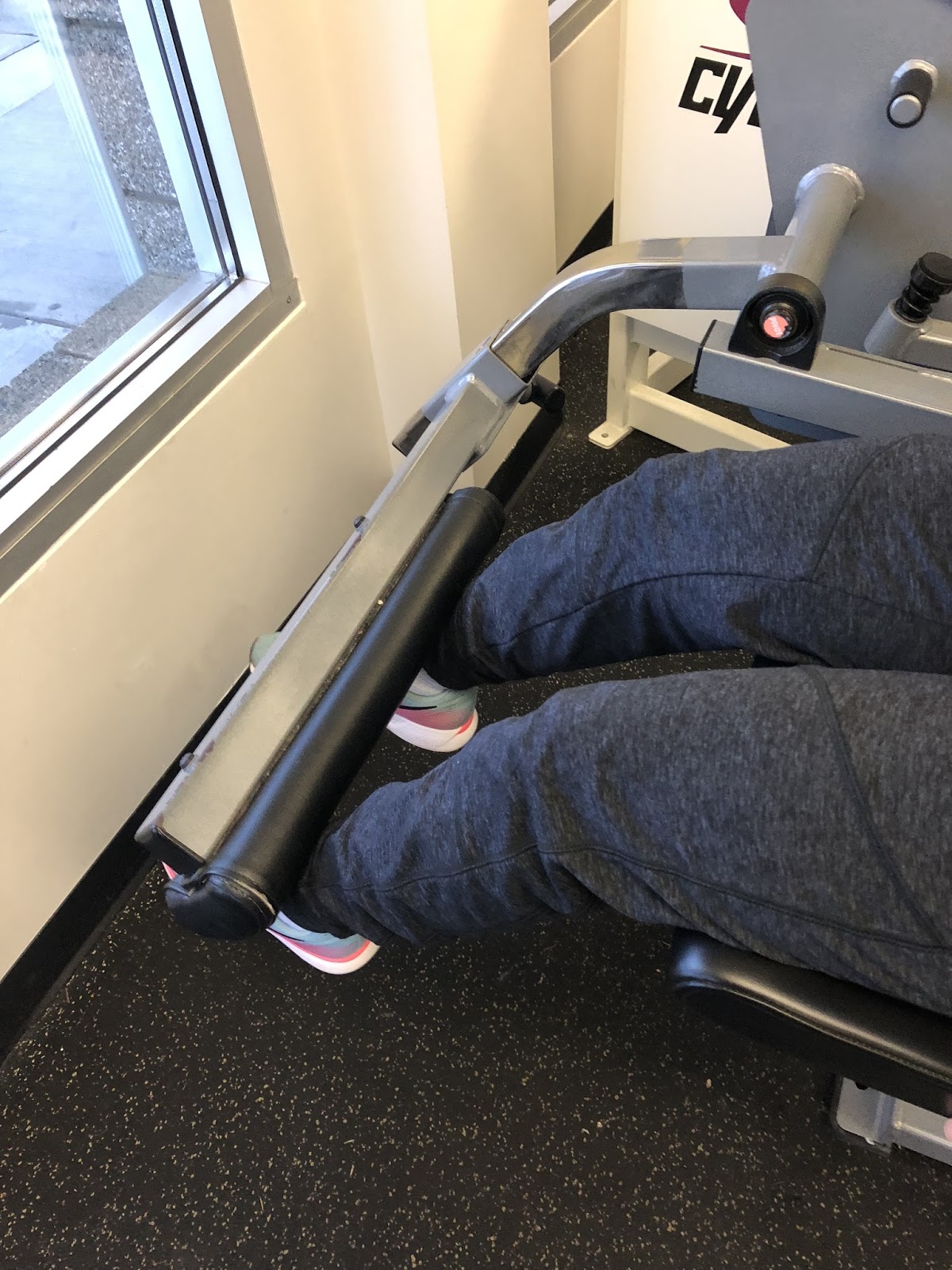
The first exercise I did was leg extensions on a machine, this works out mostly your quadriceps. In this exercise, you set the machine to your appropriate weight and slowly raise your legs up and back down. I completed 2 sets of 20 reps on the leg extension machine. Stevenson also recommends to push your self but not too hard to where it becomes unsafe (Stevenson 68).


Leg Curl Machine

Along with leg extensions, I also completed leg curls which work your hamstrings. This exercise includes setting the machine to a appropriate weight and slowly pushing your legs down and back up again. I also completed 2 sets of 20 reps on this machine. 

By working out my leg muscles 3 times a week, I am able to become I stronger hiker and become able to complete longer and more strenuous hikes. Overall, reading Stevenson's book has allowed me to grow my love for hiking and become a stronger and more educated hiker. I was able to hike more, and not just in the summer, along with more hiking experience. Do you think training is important to complete task like hiking, if so why? Thanks for reading!


Stevenson, Jason. The Complete Idiot's Guide to Backpacking and Hiking. Indianapolis, IN: Alpha Books, 2010. Print.


Saturday, January 20, 2018

Recovery and Injury Prevention

Joey Macauley
Complete Conditioning for Soccer
By: Greg Gatz

Mental and physical stress on your body precipitates from daily occurrences, from school to athletics, in which your body is the forced to resist or adapt to. In chapter 11 of Complete Conditioning for Soccer, Greg Gatz justifies valid information and daily practices to allow your body to recover and remain healthy. Initially, he explains that in order to keep your body in healthy composition, it's important to avoid overworking yourself. In the text, he says, "To develop a sound training plan, you must distinguish between volume and intensity" (Gatz 155). In essence, he's prescribing that tough workouts correspond with shorter time periods, or easier workouts can last for a longer duration. This promotes better improvement and maintenance for the mechanics of your body while participating in sports. Furthermore, Gatz specifies on essential techniques for recovering properly. This involve a nutritious diet, regular hydration, quality sleep, and various exercises such as massaging methods. Being able to commit all these aspects to a consistent daily schedule will translate into noticeable forward progress throughout training processes and performances (Gatz 157). 

(1) STAY HYDRATED!!
(2) Using the foam roller for glutes, quads, and hamstrings (book example)
(3) My ice/heat pad, smaller knot roller, and foam roller... all for recovery and soothing my small strains or injuries 

Personally
, from playing soccer up to 5 days a week and with a possible 2 to 3 games a weekend, recovery is essential for me, day by day. After reading this chapter, I now understand the specifics for what I can and should be doing during and after training and competition to ensure that I continue maintaining and improving my muscle composition. The evidence I identified has altered the way I condition and train while making sure I'm avoiding injury or strain from overworking myself individually and with my team. Then, the information I paraphrased highlighted the check-list for the basics of what I need to incorporated while being involved with soccer. I know school hinders the amount of sleep I'm able to get, but I'm now aware of the extreme importance of hydration and nutrition, along with the use of different equipment to handle the soreness, knots, and stress with my muscles. 


Have you had to deal with over-stressing your muscles with an activity? If so, what methods did you do to recover efficiently, and if not, what would you have done?

Work Cited: 
Gatz, Greg. Complete Conditioning for Soccer. Human Kinetics, 2009.

Friday, December 29, 2017

Conditioning for soccer: Speed

Joey Macauley
Complete Conditioning for Soccer
By: Greg Gatz

Similar to the other components of soccer, including strength, flexibility, etc., speed can be taught and improved and isn't solely determined by inherited skill/potential. In chapter 7 of Complete Conditioning for Soccer, Greg Gatz defines speed and how to develop a program that incorporates drills and exercises that specify on the particular mechanics of your body. He explains how speed training for soccer should consist of combinations of acceleration, tempo changes, and multi-directional acceleration, which then correlates with the aspects of agility training. Also, Gatz warns that consecutive workouts dedicated to speed must be avoided to maintain forward progress by not over stressing the nervous system (Gatz 99). Then, Gatz specifies on how to design a program in order to effectively build upon your speed. He says, "To improve top-end speed, you need to understand and practice the basic mechanics of sprinting, including posture, stride frequency, and stride length..." (Gatz 100). Then, he adds, "When planning your speed development program, allow sufficient recovery between intensive bouts and adjust the volume to lessen the chance of over training" (Gatz 102). Following this information, Gatz lays out guidance plans and written tutorials for developing a speed program that incorporates various drills such as...
(1) Hill Sprints: Forces your steps to be quicker up and down. The resistance from the gradual incline works on your acceleration and stretches your muscles
(2-3) Get-up: Accentuates the driving force of acceleration and teaches you to use your arms to generate more power in motion. 
In essence, this chapter really taught me how to possibly increase my speed and agility which plays a major role in how players and teams are able to dominate. I now understand the correct methods or processes for how to improve my speed and I'm anxious to continue applying them to how I train. After reading the evidence I paraphrased, it now easier to strategically and effectively created a plan that will enhance the mechanics of my muscles, along with doing it safely in regards to muscle health. Furthermore, similar to how flexibility and balance training are separated into different styles of exercises, the quoted evidence that I included really made it more clear for me on what I could work on and what drills correspond with various focuses. All in all, I may not be the quickest player out there, but at least this chapter has given me valuable knowledge to keep moving forward. 

Do you consider yourself to have more speed then others? If so, how have you obtained it, and if not, what do you seek as the best plan in improving this component?

Work Cited: 
Gatz, Greg. Complete Conditioning for Soccer. Human Kinetics, 2009.

Sunday, January 29, 2017

Setting Up for the future (post 5)

So as this is my last post I thought I should reflect on the progress I've made over this time period while also showing what I'm going to do following this.

The best way to show the improvement I've made is through not only my pure times but also through the swim diary that Salo had talked about keeping. This shows more of the statistics that are all extremely important to how I ended up getting the time I got.

Displaying File_000.jpeg
(The Top is the current and the bottom is the original)

Now I went back to the book to try and figure out where exactly I should go from here. What I found where I should go from here is what Salo calls Period swimming. Salo explains it as, "the scientific and systematic process of designing a season by breaking it into various phases" (Salo 185). He then goes on to explain what explains the phases are. First you would start off your season off with preparation and training then moving on to build stroke specific strength. Then you should finish that phase in time for your big competition part of the season and once that ends spending some time with rest and recovery. (Salo 186).

So what I'll do now is talk to my coach about how we can work in the sets and training I've learned in to book into our actual practice. The final question I really have is whether or not you have noticed these four phases in some way in your sport season?

Tuesday, January 24, 2017

Continuing the Dryland (post 4)

So since I posted my last post I've continued the basic workout that Salo had said to start with. After doing them for a couple of weeks I felt ready for what he considered to be "the next step" in perfecting and improving my swimming abilities.

What he says you do after the basic work outs is you begging to work on your abdominal and the general core of your body. He says you need to work on your core because, "If there is a weak or broken link, it can compromise the integrity of the entire chain" (Salo 90). What he means by chain is each individual body part. And if one is weak than you swimming will suffer as a whole since the one part is messed up.

How he suggested you fix your core is through a series of workouts. These range from various forms of planks in different positions. Then also doing certain types of core stretches. He says that while doing these you go through steps of beginner, intermediate, then advanced. Switching from each level is determined with how easy each exercise is for you (Salo 92).
Displaying plank.jpegDisplaying leg  drop.jpeg
(On the left is me doing planks and the right is leg drops)

What i was wondering though with the new things tat I've read about Salo's book do you think that being weak in one part of your body will really hamper your swimming ability or is he over reacting that part?

Wednesday, November 30, 2016

Art of the Knuckle Ball

Square-cut fingernail (allowing
more of your nail to be on the ball)
Normal fingernail

Most knuckle ball pitchers throw their knuckle ball of their fingernails, which they carefully cut into a square shape (Adair, 55). Having a square-shaped nail allows you to maximize the amount of surface area you can apply to the ball as you are throwing it. The most important thing a pitcher wants while he is pitching to a batter is control. Reconstructing their nails to have the maximum amount of control as possible can be a key difference between a successful knuckle ball and an easy target for the batter to swing at. Personally, I prefer to keep my fingernails at a fairly long length so I could flick the ball with more potential. But, this book believes maximizing your control is more important in pitching.
To counter my long-nailed tactic I use four
fingers to gain as much control as possible

When throwing a knuckle ball, the idea is that the ball spins only about 1-2 times from the moment it leaves the pitcher's hand to the time it hits the plate. This is one of the slowest types of pitches thrown in baseball but also one of the deadliest as well. Because of its lack of spin, the knuckle ball creates more drag on the seams and essentially generates more movement. In fact, it has so much movement that the catcher actually has difficulty catching this type of pitch. A catcher known to catch for knuckle ball pitchers states that "It was easy, I just wait until the ball stopped rolling and then I'd pick it up" (54). Ever since I was 6 years old, I played on some baseball team and practiced every year, making it my main hobby. But I haven't started to actually try to improve and become more competitive until the last few years or so. I practiced so much with my pitches, that I can successfully throw 7 different types of them, (Fastball, Change-Up, Slider, Knuckle, Knuckle Curve, Curve Ball, and Side-Arm) where professional pitchers have 2-3 pitches at the most. I've never been thrown a knuckle ball by someone who knows how to throw a good one, but I can see the catchers that struggle (even in the MLB) to catch one.

Eddie Cicotte was the great Chicago "Black Sox" pitcher, who threw his knuckle ball without using his fingertips/fingernails. On the other hand, the worst part about the knuckle ball is the lack of control while in the air. If it breaks sharply, it will be harder for the catcher to successfully catch the pitch and if it doesn't break, it will be no more than batting practice for the batter to easily hit it out of the park. These key differences make this pitch both amazing and risk-taking to use.

What do you think is more important, having more control (causing less movement) or having more unpredictable movement (with less control)?

Adair, Robert Kemp. The Physics of Baseball. New York: Harper & Row, 1990. Print.

Monday, January 25, 2016

Trent DeLucia: Training Your Dog 2

When you think of dogs playing fetch, I bet you don't really associate any training going along with it.  I did too until Bear came along.  When I try playing fetch with him, he runs to get the ball or toy that I threw and never brings it back.  He either starts to play with it or he picks it up with his teeth and trots away.  This took all the fun out of the game because I'd be the one chasing him down to get the toy back.  Bear's odd way of playing fetch inspired me to teach him the right way to do it.

"I used to wait up to ten minutes at the door calling Tucker's name [her dog] for him to return back inside.  I grew very impatient so I decided to do something about it.  After countless trial and error procedures, I finally discovered that the best solution was luring my dog back in with a treat (Fugazza 2)."
Fugazza, Claudia. "Imitation." Do as I Do: Using Social Learning to Train Dogs. Wenatchee: Dogwise, 2014. 2. Print.

This personal story from the author of Do as I Do can tie in perfectly with what I am trying to accomplish.  Claudia's whole goal was to make her dog come back to her easier which is very similar to Bear's problem when we play fetch.  Bear has no motivation to return the toy back to me after I throw it because he has what he wanted.  A treat would entice Bear and give him incentive to return the toy I threw him.  Claudia Fugazza included some tips for going about her training with Tucker:

"Only give your dog a treat every one or two attempts so they don't become fully accustomed to receiving one.  If this doesn't work for your dog I also recommend rewarding a treat two trials in a row, then the next two trials only give encouragement (Fugazza 2)."
Fugazza, Claudia. "Imitation." Do as I Do: Using Social Learning to Train Dogs. Wenatchee: Dogwise, 2014. 2. Print.

I tried rewarding Bear with treats every other time I threw him the toy to fetch.  This didn't work too well at first because he only came back to me when a treat was involved.  I then decided to try Claudia's method of two trials with a treat, then two without.  This was a lot more effective because Bear started to understand the motion of coming back with the toy.

I did Claudia's method for about thirty minutes and then started to only give Bear a treat every four or five times he ran back to me.  By this point, Bear was hurrying back to my feet right when he retrieved the toy.  He finally started playing fetch and after about an hour I didn't have to give him anymore treats entirely!  Was it unusual for Bear to need training on how to fetch?

Monday, November 30, 2015

Trent DeLucia: Training Your Dog

I chose training my dog because I thought it would be fun to incorporate him into a school project.  His name is Bear and he is three years old.  None of my family members have taken the time to teach him any cool tricks or train him in any special way so I took it upon myself to accept the challenge.

I had no idea where to start after I read the book, Do as I Do, by Claudia Fugazza.  It gave me a few ideas on what tricks I could teach him, but also brought to my attention that Bear has a few bad habits he should change.  Begging at the dinner table has always been annoying, but nothing has been done to stop it.  In fact, my family has been encouraging Bear by feeding him from the table to make him go away and stop growling.

Last Sunday, I decided to focus on getting rid of the bad habit of bear begging at the dinner table.  The guidelines from my book have definitely helped because he has not begged in three days. I used the plan:

"The main cognitive variables involved are:
1. Motivation
2. Attention
3. Memorization
4. Replication (Fugazza 20-21)."
Fugazza, Claudia. "Imitation." Do as I Do: Using Social Learning to Train Dogs. Wenatchee: Dogwise, 2014. 20-21. Print.

I used this 4 step guided plan to help Bear stop begging:
1. I motivated/encouraged Bear to not beg by giving him a dog treat after dinner and not giving him any more people food.
2. I switched his attention/distracted him from delicious smelling food to toys.  I would throw him a toy that I'd keep on my lap when he would come near the table.
3. I helped Bear memorize/recall his learning through telling him "No!" when he started to beg.
4. This was replicated/put into action in only four practice days and the outcome has been no begging since!

The past few days my family and I have been able to enjoy our dinners more from not being annoyed by Bear.  My mom said, "Finally, I don't have to share my food!"  Training Bear so far has been fun and effective.  Do you think that focusing on reducing bad habits will please my family more than cool tricks?

Before: Bear begging when it's dinner time.

After: Bear with his favorite toy during dinner.