Showing posts with label dance. Show all posts

Wednesday, January 24, 2018

Air Time in Aerial (blog post #4)

          Hello everyone! Welcome back to my bog. If you have never been to my blog, the purpose of my blog is to fix techniques in my aerial while in the air. This time I chose to fix what is did in the air. In the book Gymnastics Skills, Tips, and Tricks by Jeff Savage, there are many ideas to what to be working on mid-flight. I mostly focused on my head and arms. Throughout these blogs I have changed a lot about my aerial and have kept those changes. They have made my aerial a lot easier and I can see/feel a tremendous difference. One thins I was curious about was my mind air position. I never really focused on that, I only paid attention to getting over. 
          Author Jeff Savage, talks on body position as well as where your head should be in an aerial. As far as your body position you should be in a basic "straight" position in the air. The straight position is basically a pencil torso with scissor legs (Savage 6). Jeff Savage describes this in detail by saying "Hold your arms to your side, stand straight, hold your body tight by squeezing your muscles" (Savage 6). I believe the straight position is used to whip you around the fasted while making the trick look effortless and clean. The second technique to focus on in the air is your head position. Similar to blog post three, you have to spot, but this time you spot the ground. It is very important important to spot the ground in acrobatic tricks (Savage 12). Savage goes in to a deeper understanding of this by saying "Make sure you look down to see where you are going, At the the top of the move, you should be completely apart" (Savage 13).  I think this idea has a good concept but personally I'm guessing this won't help me. I feel the head position described would make me bend more backwards when the trick is suppose to be in a straight line. I sounds very dangerous.
          After trying these new techniques, there were a few problems. Like I had guessed, having your head arched back makes it nearly impossible to do an aerial. I couldn't take a picture because I put my hands down every time because it felt so uncomfortable and risky. To prevent injury, I decided to stop. For some people, this technique could have been helpful, which is why Jeff Savage wrote about it. On a good note, keeping my hands by my side looked very clean! It felt very comfortable and helped me whip a round fast.  


          My aerial is now very clean with all the changes made through this book! I am very pleased will the the results and feel all aspects of my aerial has been recognized and progressively gotten better. With this, my next blog will be on something other then flipping! Tune into my next blog post when I steer away from tricks and try something new!


What are your favorite stretches? What stretches do you think would be most helpful for aerials?


Savage, Jeff. Gymnastics Skills, Tips, and Tricks. Enslow Publishers, Inc., 2012.

Thursday, December 28, 2017

Why a Strong Core is Important

I have been dancing since I was three years old. Ever since I was little, I remember my teachers always stressing one important point: The core.

Every move in dance, especially ballet is supported by a strong core. As the caliber of dance becomes more difficult, the more important a strengthened core is. It supports you in turns, jumps, posture, and balance which was something I was hoping to improve. 

Finding your center will help you in all aspects of dance. In Ballerina Body by Misty Copeland, Copeland also stresses the importance of a strong core. There are numerous different exercises that help you develop a strong core all targeting different areas. Copeland has recommended a few especially for those in dance. 

The first is a proper plank where your elbows are on the ground as straight as possible. Your hands can be clasped or separated. It's important that your body is straight and you're not letting your back scoop or arch down (Copeland 54).


Next is a variation of sit-ups/crunches. Many types of sit-ups can be harmful to your back and put a strain on your neck. Copeland recommends crunches where only your upper back comes up to reduce stress on the back. You can keep your arms behind your head or straight out. Also for a greater challenge, lift your feet of the ground. The main tip is to relax your neck as much as possible to reduce strain and any possible injury (Copeland 55).


Copeland also touches on why it's important to maintain good posture. Core and posture work together to make you stronger overall. Standing up straight may also help improve balance (Copeland 34-35).
A strong core will help me achieve my goal to gain better balance, and improve my dancing overall. 

Copeland also stresses the importance of also not pushing yourself too hard, saying that this can bring a negative mindset, and can hold you back on your journey. "When you skip a day of exercise, that;s not a reason to berate yourself- or a reason to abandon your workout plan all together. Remember that tomorrow can be a new beginning, a chance to recommit your aspirations" (Copeland 218). 

How important is a strong core in your sport? Do you have any tips or workouts that you recommend to others?

Copeland, Misty, et al. Ballerina Body: Dancing and Eating Your Way to a Lighter, Stronger, and More Graceful You. Sphere, 2017.

Wednesday, December 27, 2017

Technique #3 Changing Run Up into aerial pt 2

         Welcome to my third blog! In my last blog, I went over what this blog was going to be on but for a recap, this is going to be changing my run up part two! There were two techniques in the book that I wanted to try, one was last blog and this is the second one. The second run up will be a chaines turn!

          The book this blog is based on, Top 25 gymnastics skills, tips, and tricks by Jeff Savage, had a lot of great information on chaines turns and using them as a run up. Instead of an actual run, a chaines is a type of turn. I chose to focus to focus on this because in a dance routine, a turn could look better than just running up. "A chaines is a three point turn that on the third step you use as a prep in to your aerial. The last step you need to make sure you do into a deep plie so you have enough power to do your aerial. Since you are turning in to it, it is very important to spot." (Savage 24). I think this will help me work on my strength in my aerial. Using just 2 steps and one prep takes a lot of strength for this chaines turn. Spotting is picking a point on the wall (or whatever you're facing) and looking at that point as you turn until your head cant reach to look at in anymore then whipping it around and continuing to turn and find that same spot (Savage 25). Spotting is very important when you add a trick after turning because it will help you not become as dizzy.


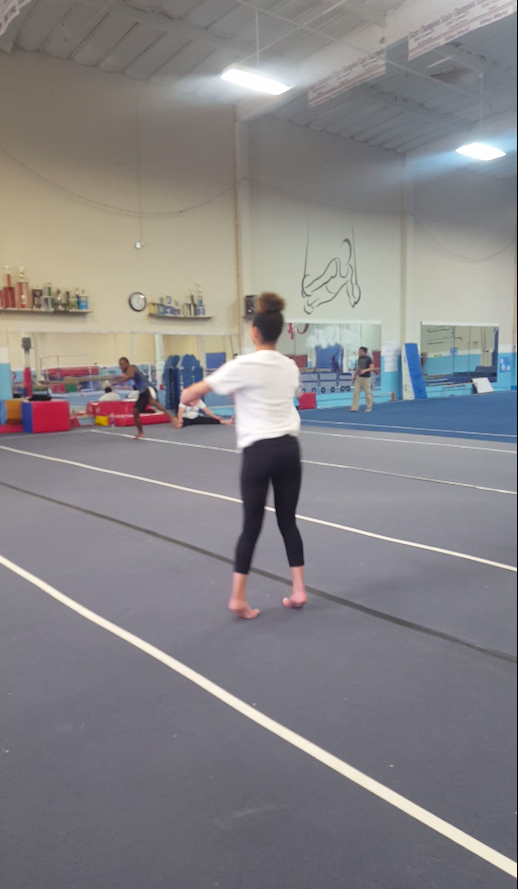
          Trying out this technique,  I went to  Metropolitan Gym. Using this skill was so far the most helpful. I would have never thought of turning into an aerial, but it comes very helpful in dance. Doing it on spring based gymnastics floor actually didn't effect the out come. I tried it on regular gym floor and dance floor and all three had the same positive outcome. I spotted hard so I didn't get dizzy and I noticed it worked really well. I tried not spotting and my aerial wasn't as strong and it was harder to do. Though it looks very nice it does take a lot more strength. In the book, Top 25 gymnastics skills, tips, and tricks, there are multiple workouts to help build up the strength needed. Even when I did spot, it still took a lot of strength. As you can see in the pictures, my head is pretty close to the ground compared to last week (you can see photos from then in my last blog), but i still feel very comfortable using this technique. It has changed me as a dancer/gymnast because it has made me gain more strength.

          Thank you so much for reading my blog! I'd like to end with the question of, what do you think the most used muscle is in an aerial? Why do you think the book says it takes so much strength to do this trick?


Savage, Jeff. Top 25 Gymnastics Skills, Tips, and Tricks. Enslow Publishers, Inc., 2012.

Blog Post #2 Changing my Run Up in to Aerial

           Hi, thank you for coming back to my blog! This time I really focused on my run up. A run up is basically how you get into your trick, like your prep. In Gymnastics skills, tips and tricks, author Jeff Savage had a ton of great prepping techniques. Because of last time when I was sinking to the sand, I thought switching my run up would be a great thing to work on.

          In the book, they used two different techniques to run up that I thought would work for me best. One will be my second post and the other will be my third post. One was the standard run, they explained you should take as many steps as you feel comfortable (16). The author Savage explained this by saying "Pump your arms and keep your palms slightly up. Raise your knees high." (Savage 17). I think they said raise your knees high because it will give you the most over all power. If you have a lot of space, I believe this is the best technique because it will take more steps when you run up this way. It takes a lot of power to jump high in those runs. With each run you do, you are creating momentum which is more and more power. Before testing this technique i believe this is going to give me a lot of power.


          This time I tested out this technique at the Metropolitan gym. I had the chance to use real gym floor which changed my aerial. Real gym floor is spring based which makes it easier to do tricks. Doing the standard run up caused me to have a lot of power. It felt as if I just floated through the motion. I had a lot of power with the standard run up and the spring floor. For this technique I believe it is the best if you are going to be on spring floor, if you are going to be on gym for or dance floor the next blog post will be best for you! I was very comfortable using this technique on spring floor. If you look at how far my head is from the ground, you can tell that I got a lot of power from the standard run. Technique helps me to have a lot of power.

          Overall, I believe that this technique is very promising but isn't for dancers. With that, what do you think a chaines is? Want to find out? The next blog will tell you all about it!


Savage, Jeff. Top 25 Gymnastics Skills, Tips, and Tricks. Enslow Publishers, Inc., 2012.

Tuesday, November 28, 2017

Getting Started: Goal Setting and Planning

"But thanks to mentors who believed in me, hard work, and perseverance, I have been able to rise to the top tier of one of the world's premier ballet companies and to achieve a life balance that makes me feel centered and whole" (Copeland xi). These are the words of Misty Copeland, the first African american principal dance at the American Ballet Theater, a world famous company.

In her third book Ballerina Body: Dancing and Eating Your Way to a Leaner, Stronger, and More Graceful You, Copeland shares the advice she has acquired in her rather short career. Her impressive confidence and strength after a difficult past shines through her advice. Misty went from being told she wasn't skinny enough to be a professional dancer as a teenager, to becoming one of the worlds best. Her story continues to inspire many young girls.

Ballerina Body is a self-help book, to guide someone through their journey of becoming content, fit and healthy. Copeland has split her book into four parts: mind, motion, meals, and mentors. My first post will focus on her tips from the first section, mind.

Copeland describes the book as a guide through a journey of self improvement. In the first section, she explains how to prepare for this improvement on a mental level. "If you don't have clarity about what you want to accomplish, you can't plot how you will get there" (Copeland 12).
She gives the following tips:
  • Keep a Finish Line in Sight: Always try to accomplish your goals and set new, more challenging goals once you have . 
  • Gain Motivation: Take in motivation from the little things around you to help you grow and develop more confidence about your accomplishments. 
  • Visualization: Visualize what the end result may be, think about how content and satisfied you will feel when you meet your goals. 
  • Keep a Journal: Make a scheduled time in your daily routine to reflect on the days progress, record how you feel and why. 
(Copeland 11-16). 


I will be using all of of these techniques myself and for a tangible record, I will be keeping a journal to reflect on how I feel.


After some thinking about me as a dancer and person right now, I've though about things I could improve on. I have decided to set the following goals:
  1. I will try a variety of exercises to help strengthen the muscles in my body, and to become stronger overall. Specifically, I want to focus on core and leg muscles. 
  2. I will work harder to improve my balance, which is something I struggle with. Strengthening my core will also help me find my center. 
  3. I will maintain focus and motivation through techniques like visualization, and thinking about how I will feel in the future after my goals are accomplished. 
  4. I will eat a more balanced diet containing fruits and vegetables, to help support the new lean muscle I will be working toward.


Though these are complex, I feel they are a right fit for me right now.

What goals have you set in your life? Do you have any advice or tips for staying motivated through the journey? What helped to keep you on track?

Copeland, Misty, et al. Ballerina Body: Dancing and Eating Your Way to a Lighter, Stronger, and More Graceful You. Sphere, 2017.

Monday, November 27, 2017

technique 1 'step out' in Aerial


          Hi everyone! Over these few months I will be blogging on new techniques to help my aerial. For those who don't know, an aerial is basically a cart wheel but with no hands. They can be used in gymnastics, dance, or just for fun. When I was in fourth grade I taught myself how to do one in my front yard and it has stuck ever since. I thought it would be a good idea to learn different techniques so that I could improve and use it in dance. Being a part of the chats at Kentridge I have to do many tricks and using better techniques will help me make my aerial more clean (look more put together).  I read the book Gymnastic Skills, tips, and Tricks by Jeff Savage. It was a very interesting book for me because i go to see different techniques to do tricks that I would have never tried before. His book gave me the inspiration of my first correction in my aerial. 

          The first technique from the book Gymnastics Skills, Tips, and Tricks, is changing my step out. The 'step out' is basically your landing. I usually do my aerial by landing one foot the opposite way from my start then rotating 180 degrees to face the same way I started. In the book it says how you should body should be in scissor position. The author explains how you should rotate as you would in a cart wheel, (like how I did before but without the turn around) facing the opposite direction as started (13). In the book, the author says, "Land in a step out, hold your feet a few inches apart. Most important, bend your knees slightly while landing" (Savage 13). Through this technique I learned to change my step out. I end my aerial as the book says by facing the same way you started. 

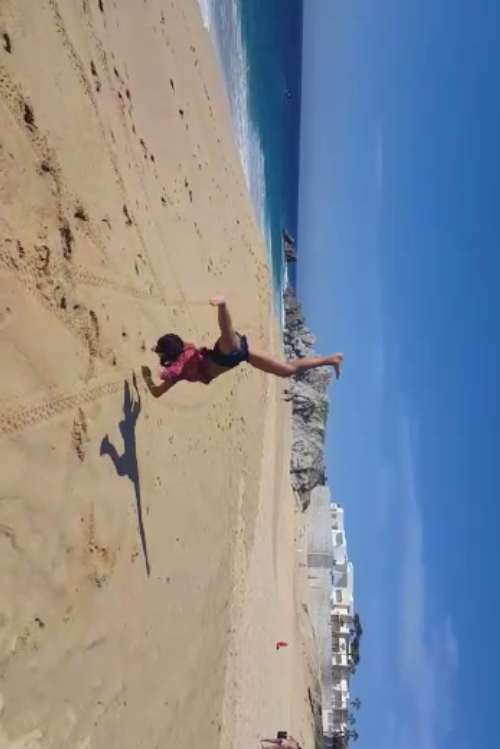
          By using this new technique it helps me be able to add tricks. In the images below you see that I do my tricks and land just as the quote said to. I found this technique to be easier on even ground like regular wood gym floor. Landing with your knees slightly bent helps so your knees don't lock or snap. Doing it on uneven ground, like sand, was harder because while prepping you would sink into the sand. Once I  get more familiar with the technique, it should be easiest over all.  

Question: Do you think that my original and new technique take different amounts of strength? 


Savage, Jeff. Gymnastics Skills, Tips, and Tricks. Berkeley Heights, NJ.: Enslow, 2012. Print.