Showing posts with label Playing. Show all posts

Saturday, November 25, 2017

Learning the Piano: The Basics

Learning the Piano: The Basics
Nathan Cheng
How to Play Popular Piano in 10 Easy Lessons, Norman Monath

Learning a new instrument can be equally challenging and rewarding. Hopefully, as one's skills with the instrument progresses, so does their enjoyment. Learning the piano has always been something I had thought of doing (seeing as how there's a piano in my living room) but never had the time to do.

However, acquainting myself with a completely new instrument seemed... daunting. My contextual knowledge of music stems from being in school band where I play the clarinet. The thing with the clarinet is that it is limited to playing one note at a time. On the other hand, a piano can play multiple notes, which means it is able to play melodies and harmonies and chords.

In "How to Play Popular Piano in 10 Easy Lessons", Norman Monath explains in his introduction, "You will learn how to play melodies with your right hand... and how to play chords in different ways so that you can add interest and expressiveness to your renditions" (Monath 16). This excerpt illustrates the complexity of the piano (compared to a clarinet). It's ability to play chords and melodies makes it differ from other instruments (Monath 16).
Playing notes on right hand
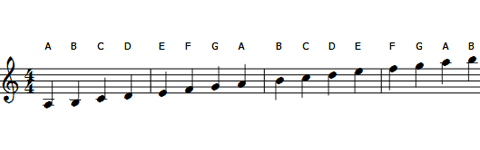
Playing the notes with my right hand was fairly straightforward. I'm familiar with the notes since it is the same treble clef (The swirly symbol at the far left of a sheet of music that dictates what the notes are) as the clarinet. For reference, here is the treble clef and its notes.
Treble Clef
Treble clef notes

Playing notes on left hand
However, acquainting myself with the bass clef notes on my left hand was, to be frank, a lot harder than I had perceived. Learning how to play chords was easy, but playing notes in the bass clef with my non-dominant hand was challenging. Since the notes are written the same way as the treble clef, I almost always instinctively think of the treble clef note, not the bass clef note. For reference, here is the bass clef and its notes.
Bass Clef
Bass clef notes


Verily, I think that memorizing the notes on the bass clef will be the most challenging aspect of learning piano, though once I pass this hurdle I think that this endeavor into the piano will have its rewards.

My question is; To those who play instruments on the bass clef, is there any acronyms or tricks to remembering the notes? For the treble clef, the acronym "Every Good Boy Deserves Fudge" can be useful for remembering the notes on the lines, and knowing that the notes on the spaces between the lines spell "FACE" is another trick to recalling the notes. Is there anything similar to the aforementioned that works with bass clef?

Monath, Norman. How to Play Popular Piano in 10 Easy Lessons. Simon & Schuster, 1994.

Monday, November 30, 2015

Alfred's Basic Adult Piano Course - Jack Thorsland

What makes one pianist stand out from the others? what makes one pianist great? 

Hello Everyone! For me, learning piano was an easy choice. I believe that the piano is the most important instrument in music. It is arguable that the drums may be considered more important, due to them being the first of instruments, but the ability to play piano opens many doors in the musical universe. This consists of; The ability to identify notes, to gain a "musical ear", and to learn why things generally sound good or bad. Upon beginning my book, i learned one thing. There is a science to playing musical instruments correctly, actual theories that revolve around what makes a player not just good, but great.

The first words of my book, are quite literally "BE KIND TO YOUR HANDS!" (Palmer 4) The author is VERY confident in his belief of hand condition. He explains how it is necessary to wear gloves every time I have to lift a heavy object, or even use hand tools such as screwdrivers or wrenches. This is only the beginning. (Palmer 4)

"Before practicing, it is good to soak the hands for a few minutes in warm water. This promotes circulation. Many concert pianists use very warm water on their hand before beginning to play. Towel the hands vigorously until they are dry, then hold your arms out with the hands dangling from the wrist, and shake out your hands rapidly for a few moments." (Palmer 4)

I have already changed my outlook on playing piano. what Palmer is explaining is that there is much more to playing the piano, then just pressing your fingers against the keys. The conditions of your hands, and the way you prepare them upon practicing or even performing, these are the traits that differentiate those who are mediocre at piano, and those who can be great.

Now, looking back on my question, i answer with this statement, feel free to quote this one day.

The ability to play piano is not influenced by the time you practice, but the manner in which you practice, and the manner in which you prepare.


This one is for you Mr. Palmer! 

Honestly, dipping my hands in warm water was one of the best ideas ever. All the activities that involve using fingers are benefitted, especially playing the piano.